What to Do When Your Accountability Partner Goes Quiet
Rediscover what caused the silence before deciding whether to revive it.

The slow fade is the most common failure mode, and it almost always looks the same. Both people show up strong in week one. Check-ins feel good. Then week three hits and someone gets a little less responsive. By week six, one of you is going it alone while the other one quietly hopes you haven't noticed. It's the gym membership in January problem, except nobody wants to admit that's what's happening.
Here's what's usually going on underneath the silence:
- Avoidance. If check-ins have started to feel like confessing to a priest every time you skipped leg day, some people just stop showing up. The check-in itself becomes the thing they're avoiding.
- Life overwhelm. Someone gets slammed at work, deals with a family situation, or has a rough health stretch. The accountability partnership is almost never the actual problem. It's just the first thing to get quietly deprioritized.
- Mismatched expectations. One person wanted emotional support. The other wanted performance tracking. Nobody said this out loud. When reality diverged from the unspoken deal, one person ghosted.
- Decision fatigue. Too many messages, too much to respond to, no idea what to even say anymore. Ghosting isn't always a choice. Sometimes it's just a passive response to not knowing where to start.
- No structure in the original agreement. No cadence, no shared definition of what a good check-in looks like, no agreed-upon consequence for missing one. No structure means no friction to drifting.
The key thing: the silence usually has a cause that has nothing to do with you. Reading absence as rejection, when it's actually just circumstance, is the first mistake that turns a fixable pause into a permanent one.
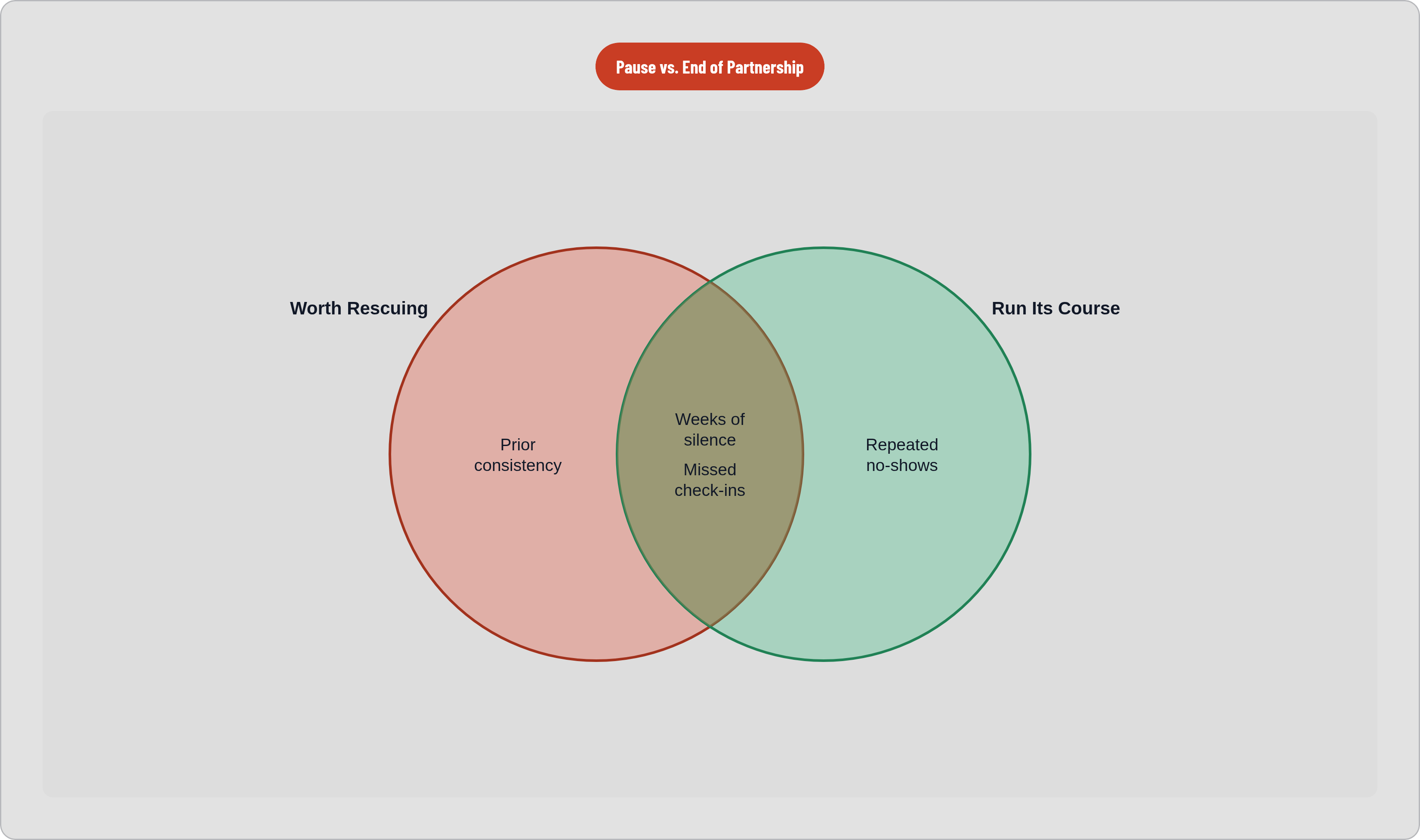
How to tell whether this is a pause or the end of the partnership
Not every silence means the same thing. A week of quiet after someone's world fell apart is different from three weeks of unread messages after a conflict.
Signs this is a pause worth rescuing:
- Check-ins were consistent and warm before the drop-off. This isn't a pattern. It's an exception.
- An explanation came through somewhere, buried in an earlier message or sent through a different channel. That makes this a lapse, not a ghost.
- The quiet lines up with something you know is hard in their life right now.
- Missed meetups with no cancellation are often just logistical. The meeting time has simply stopped working.
Signs the partnership has run its course:
- Repeated missed appointments. No acknowledgment at all.
- One-word replies that slowed, then stopped entirely.
- A pattern of re-engaging, fading, re-engaging, fading again. The third cycle is rarely worth a fourth attempt.
Most partnerships hit a rough patch during predictable low-motivation stretches, and a quiet phase during one of those stretches is more likely a pause than an exit. The move is to get curious before you assume anything, because how you read the situation shapes everything about how you reach out.
How to reach out when a partner has gone quiet
The goal of outreach is to open a door. Not file a grievance.
A few things that actually work:
- Use "I" statements. "I've missed our check-ins" lands completely differently from "you stopped responding."
- Be specific, not sweeping. Naming something concrete ("I noticed we haven't connected since the week of the 5K") is less threatening than a vague complaint about absence in general.
- Keep the first message short. A long message can feel like another obligation to someone who's already underwater. Say one or two things and stop there.
- Offer an easy yes. Instead of "do you want to keep doing this?" try "want to do a quick ten-minute catch-up this week?" Small commitments are easier to accept and harder to dodge.
- Ask about them first. If they went quiet because life got hard, leading immediately with the workout schedule confirms their fear that the whole thing is purely transactional.
What not to do matters just as much. Skip the shame-framing ("I've been doing this without you"). Skip the surveillance language ("I noticed you haven't logged anything in two weeks"). Don't list the missed obligations. Any of that turns support into pressure, and pressure is usually what drove the silence in the first place.
Renegotiating the structure when the partner re-engages
The most common mistake when someone comes back is picking up exactly where things left off. Same cadence, same format, same everything that already stopped working. That's optimistic. It's also exactly how you end up in the same situation six weeks later, doing this whole conversation again.
Treat re-engagement like starting a new partnership. Restate the goals out loud. Agree on what a weekly commitment looks like right now, not what it looked like three months ago. Confirm the format still fits both people's actual lives.
Revisit the questions that probably got skipped the first time around:
- What does a good check-in actually look like for each person? A photo? A voice note? A quick text? A call?
- How often is realistic, not just aspirational?
- What happens when someone misses? (Reflection is appropriate. Punishment is not.)
- Is the underlying goal still the same for both people?
A couple of structural things worth building in:
- Short, frequent check-ins beat long, rare ones. Brief touchpoints more often produce more behavior change than infrequent longer sessions. Counterintuitive, but it holds up.
- Agree on a small, specific consequence for missing. Not punitive. Just concrete. A small wager, an extra set, buying the other person coffee. Linking something real to a missed commitment creates follow-through even when motivation isn't there.
The tone of renegotiation matters as much as the content. "How do we make this easier for both of us?" is a completely different conversation from "how do we make sure you follow through?" One is collaboration. The other is supervision.
Keeping your own momentum while the partnership is paused
The real risk of a quiet partner isn't the silence. It's using the silence as permission to pause your own routine. The accountability gap becomes a motivation gap, and that gap compounds faster than you'd think. Miss a few days, miss a week, miss the point entirely.
Some low-tech options that actually fill the space:
- Post a workout photo to a small group, or even just to yourself. Public logging creates mild social pressure even without a dedicated person on the other end.
- Tell someone else what your goal is for the week. Not a new partner. Just a witness. That's enough.
- Log one simple visible marker of showing up: a checkmark, a photo, a short voice note. The point is consistency, not a data collection project.
Digital tools can work as a short-term bridge. Body-doubling apps like Focusmate have logged over nine million sessions across more than 150 countries, and the concept is genuinely simple: the presence of another person, even a stranger over video, increases follow-through. These tools provide structure and a sense of presence, but they lack the relational warmth of someone who actually knows what you're working toward. Best used as a stopgap, not a permanent replacement.
Accountability groups pull their weight here too. A broader network can absorb one person going quiet without the whole system collapsing around you. That's worth building before you need it.
Here's the thing to hold onto during a quiet stretch: consistency is the actual goal. The partnership is a tool for getting there. When the tool is temporarily unavailable, simpler tools will do. And if you miss something during this stretch, that's information. It tells you exactly what the partnership was providing. Use it.
When to end the partnership and how to find a more durable one
The signal that it's time to move on is pretty clear. A partner who's missed scheduled check-ins more than once without acknowledging it, re-engaged and faded again, or confirmed they're no longer in it. At that point, keeping the form of the partnership alive while both people half-heartedly go through the motions just wastes everybody's time.
How to end it: brief, direct, no blame. "I think we've both moved in different directions — I appreciated what we built" is enough. There is no need for a formal exit process or a breakup speech.
Finding a more durable partner starts with one honest question: would this person notice if I went quiet for two weeks? If the answer is no, they're not the right fit before the partnership even begins.
A few other things that sink partnerships before they start:
- Stake asymmetry. A partner whose goal has vastly lower personal investment than yours will drift within weeks. The urgency just doesn't match, and you'll feel it immediately.
- No structure before the first check-in. Set the cadence, the format, the definition of what a good check-in looks like, and what happens when someone misses. Do this before the first meeting, not after the first fade.
And consider expanding beyond a single partner. Recruiting a handful of people across different contexts (a walking friend, a group chat, a workout app buddy) means one person going quiet doesn't take down the whole system. Partners don't have to be people you already know, either. A run club, a fitness class, or a structured social group builds accountability into the format itself. As career coach Cynthia Pong points out, a book club is structurally an accountability group. The accountability is just wearing different clothes.
Build something that can survive a quiet week, a hard month, or a partner who needs to step back. Because all of those things will happen eventually. The people who stay consistent through real life are the ones who planned for it rather than assuming it wouldn't happen to them.