Building a Consistent Workout Habit When Your Partner Is Not Interested
Automaticity, not willpower, sustains solo workouts—here's how to build it.
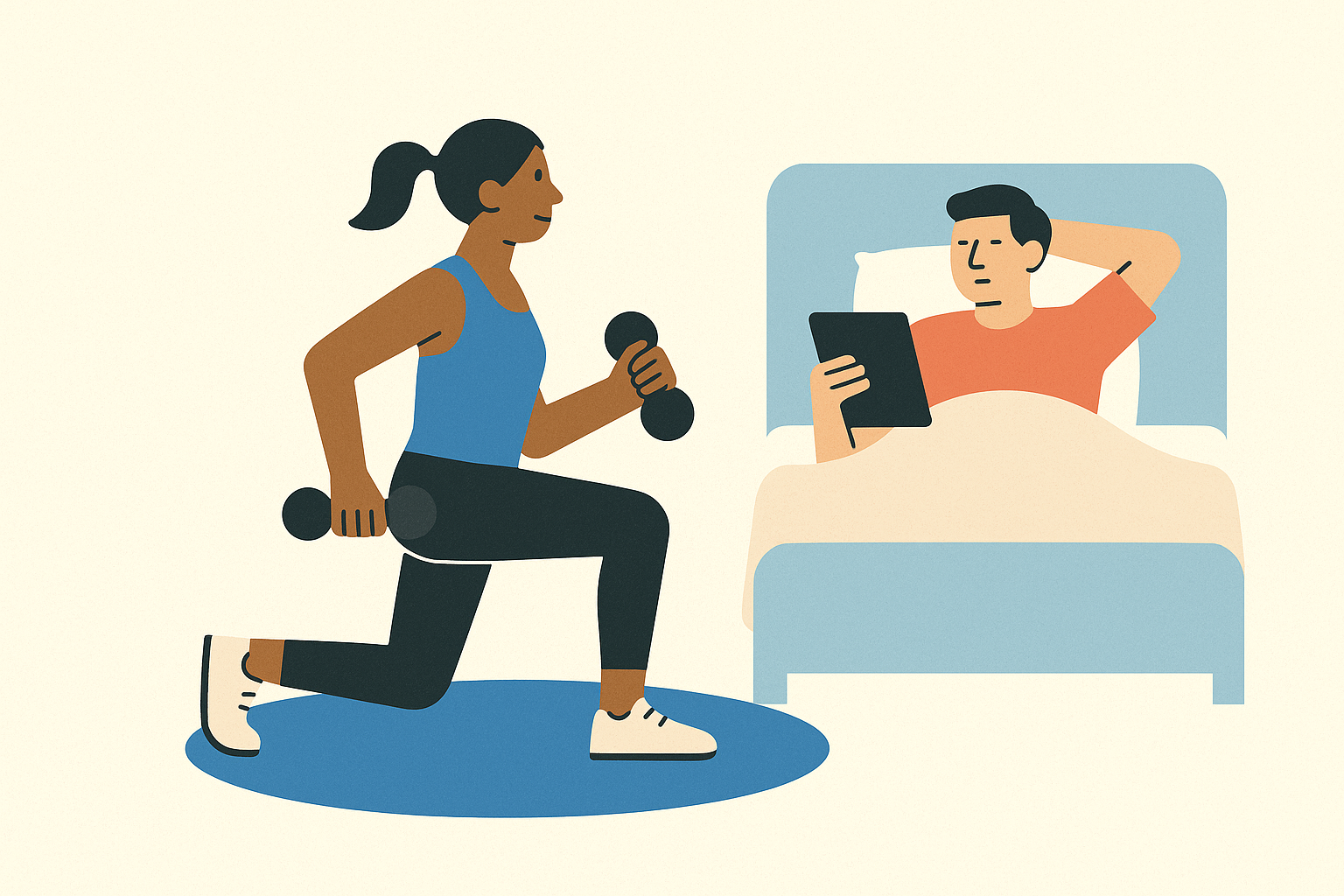
Nearly half of partnered adults trying to work out regularly get zero backup from the person they live with. That's a number, drawn from an ACE Fitness survey, found 48% of respondents said their spouse or partner didn't support their gym habits or fitness goals. So if you've been white-knuckling your way through a solo routine while your partner watches from the couch, unbothered, you are not the exception. You're the rule.
What the research says actually drives a workout habit over time
Motivation is overrated. Not as a starting fuel, but as a long-term plan. Motivation gets you to the gym on day one. It does not get you there in week eleven, on a Tuesday, when it's raining and there's a plate of nachos with your name on it. What actually keeps people showing up is automaticity. The workout stops being a decision and starts being a reflex, triggered by a cue (the alarm, the gym bag by the door, the drive past a certain exit) rather than by willpower.
Demirci and colleagues tracked new gym members over time (published in EPJ Data Science) and found a rough dosage for building that reflex: about four sessions a week for at least six weeks. Six weeks stood out as a key threshold. Cross it, and attendance shifts from something you're forcing to something you just do, the way you brush your teeth without negotiating with yourself first.
Other health habits, the simple ones like drinking a glass of water after waking up, tend to go automatic around 66 days. Full workouts take longer and vary a lot person to person, so don't panic if week seven doesn't feel like magic yet.
Here's the part fitness advice skips: repetition alone doesn't build the habit. If the workout feels aversive, monotonous, or just plain boring, the habit doesn't stick no matter how many times you show up. In fact, boredom was cited by 36.1% of people, and simply not enjoying the activity by another 29.6%, as key determinants of failing to build the self-efficacy needed to keep exercising. Translation: grinding through a routine you hate is not discipline. It's just a slow way to quit.
The relationship friction that derails solo fitness, and why it goes unspoken
Here's a pattern therapists see often enough to name it: one partner starts working out, gets into it, and it becomes part of who they are. Then, almost on instinct, they want their partner to come along. Justin Dodson, a therapist who works with men and couples, says: "Shaming a person into doing something won't be sustainable." One sentence captures the whole problem.
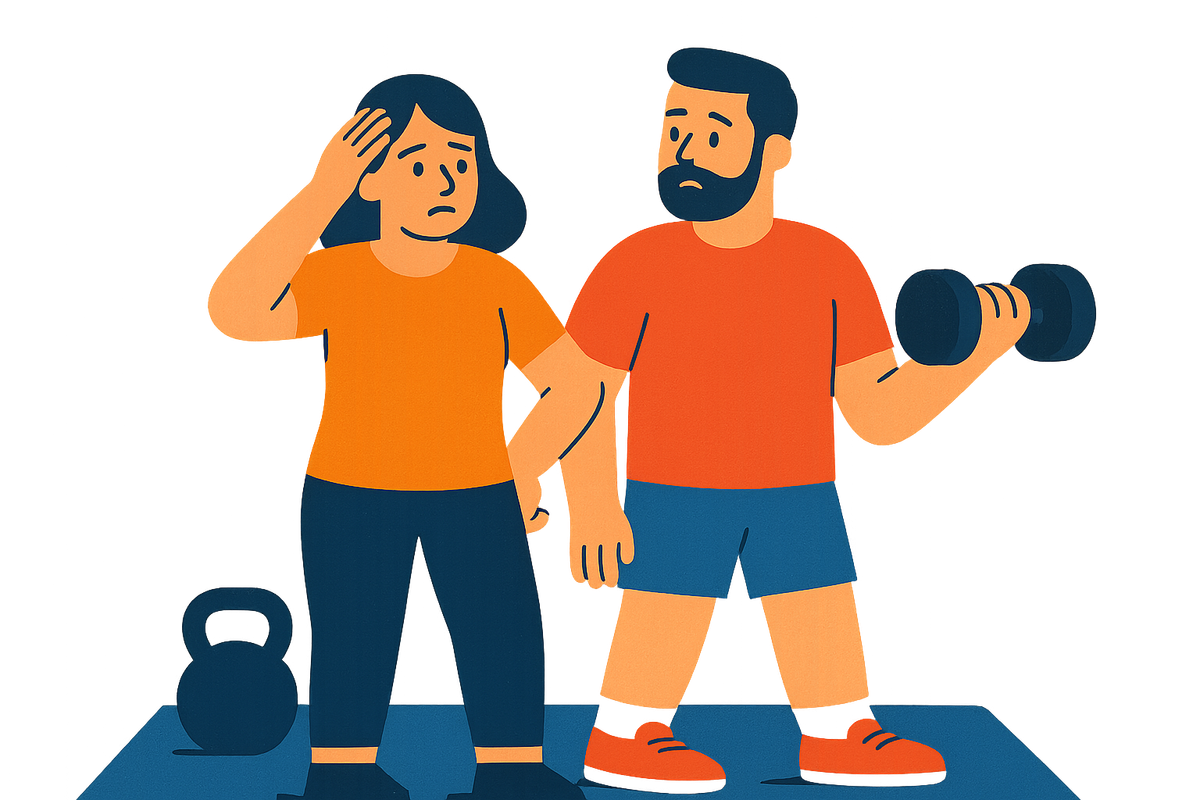
The exercising partner starts to feel like a nag, or worse, guilty for wanting the gym time in the first place. The non-exercising partner starts to feel judged, even if nothing was said out loud, because nothing needs to be said out loud. Bodies talk. Calendars talk. A protein shake in the fridge talks.
Underneath both reactions sit two quiet, mostly unspoken fears. The one working out worries about outgrowing the relationship. The one not working out worries about getting left behind, or worse, found lacking by comparison. Neither person says this directly, obviously, because who wants to admit that out loud? Instead it comes out sideways: sarcasm about "gym time," a suspiciously well-timed offer of takeout on leg day, or a flat refusal to ask how training's going.
None of this makes a fitness gap a relationship red flag. Two people can both value their health and still want completely different things from their bodies, one training for a marathon, the other perfectly happy walking the dog and calling it a day. Accepting that gap, instead of trying to close it, tends to lower resentment for both people. And the hardest line worth drawing here: a partner is not a renovation project. Confusing "workout buddy" with "person I need to convert" is a category error, and it tends to cause exactly the kind of damage it was trying to avoid.
Scheduling workouts when shared time is the default currency of the relationship
In a lot of relationships, time together functions like a currency. Evenings, weekends, the in-between hours, that's the stuff the relationship runs on. Every hour spent at the gym is an hour withdrawn from that account, whether anyone says so or not. Generic fitness advice keeps missing that the scheduling problem is a relationship-economics puzzle, not a calendar puzzle.
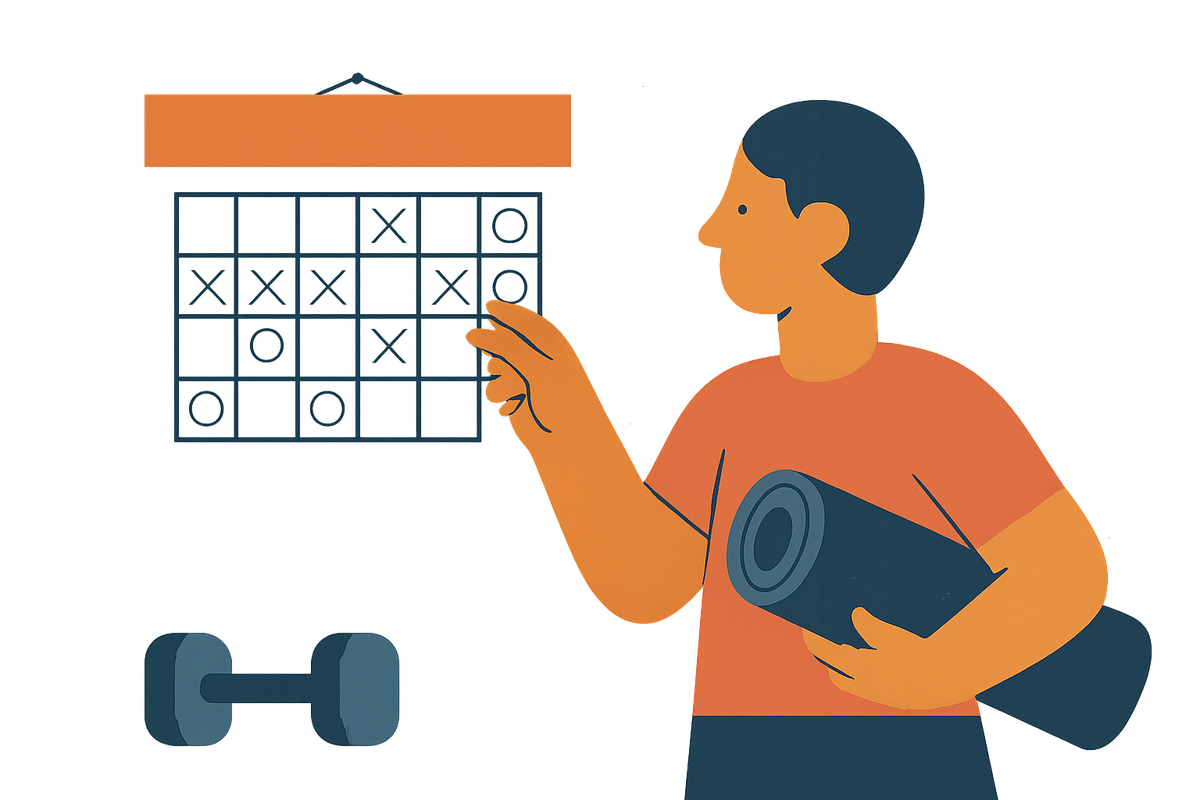
The fix isn't complicated, though it does require some spine. Treat the workout slot like a commitment you already made to someone else, a dentist appointment, a work call, something non-negotiable. Block it, name it, put it on the shared calendar if there is one. Don't leave it floating as a "maybe I'll go later" because "later" always loses to whatever's happening in the room right now.
Training before the shared part of the day even starts can reduce the sense of trade-off, since nothing gets taken from shared time. And announce the plan ahead of time rather than dropping it in the moment ("heading to the gym, back in an hour") because a surprise always reads as a withdrawal, even a small one.
Protect a little shared physical time too, a weekend walk, a hike, cooking something together after. Not as a consolation prize. As proof the relationship isn't just competing with the treadmill.
Replacing the accountability that a partner would have provided
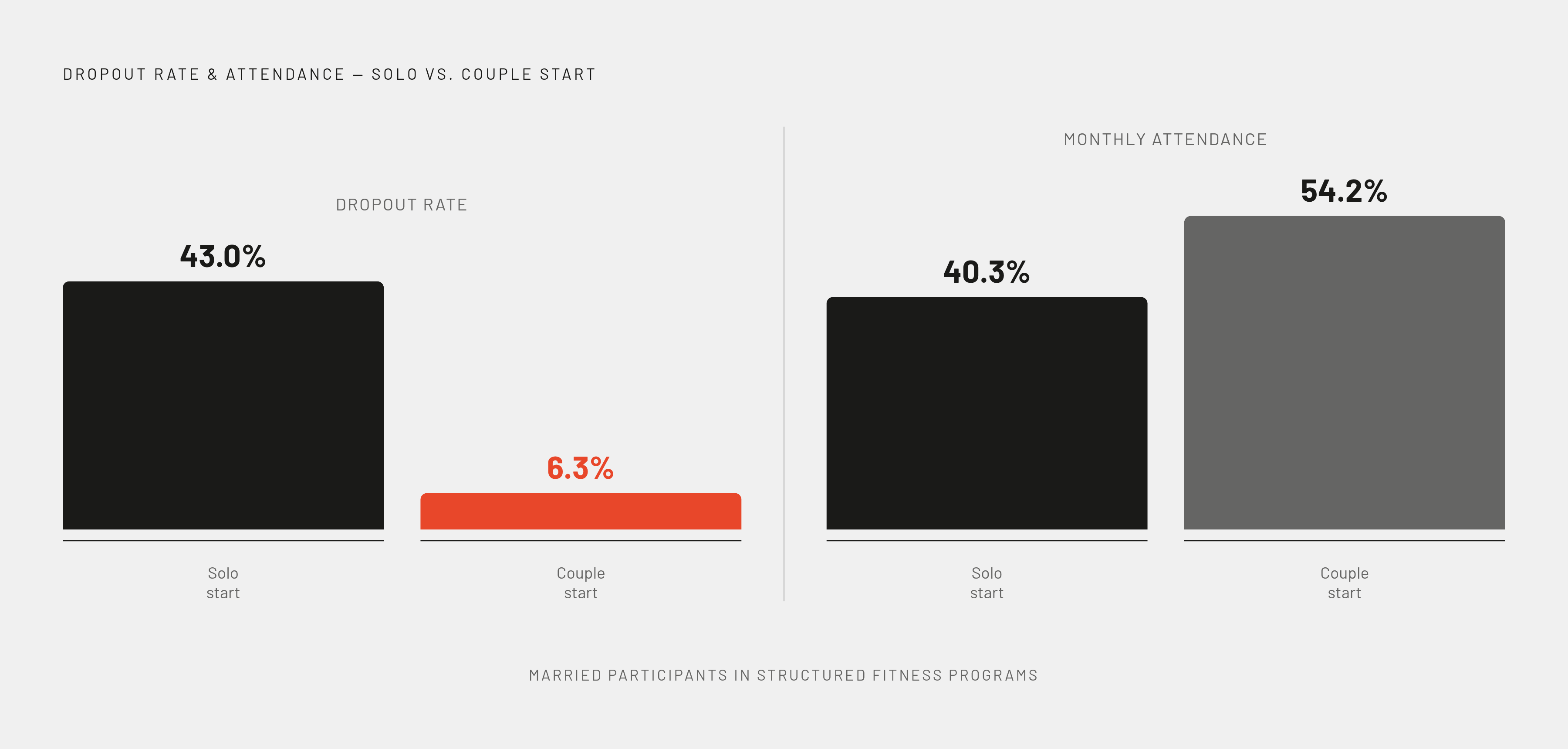
The dropout numbers here are not subtle. Married people who start a fitness program alone drop out at a rate of 43.0%. Married people who start one with their spouse drop out at 6.3%. Monthly attendance tells the same story: 40.3% for solo starters, 54.2% for couples who joined together. That gap is not a rounding error, it's the difference between quitting by spring and still going in December.
A Stanford study following 269 men and women aged 50 to 65 over a full year found that general social support (friends, family, cheerleaders of any kind) mattered less than exercise-specific social support. And support at month six was the strongest predictor of whether someone kept going through months seven through twelve. In plain terms, you don't need a hype squad. You need people who show up to the same 6 a.m. spin class.
Group classes work for this reason, peer accountability and a little social pressure baked right in. Apps and platforms fill a similar gap for people who'd rather not join a class. Peloton replicates a live studio, leaderboard and all, from a bike in the living room. StepBet adds real money to the mix, betting on your own step count, which turns out to motivate a certain kind of person extremely well. Apps with gamified features see retention rates up to 50% higher than plain tracking apps, and the social fitness app market overall hit $3.5 billion in 2024, on track for $10.8 billion by 2033. The broader fitness app market is bigger still, $12.12 billion in 2025, projected past $33 billion by 2033. Point being: the field is exploding, and social features (not just step counts) are where the growth is.
Whatever the platform, the principle is the same: shared accountability structures, progress check-ins, friendly wagers, encouragement, can keep two people connected around a goal without demanding they share a gym membership.
Building motivation that does not depend on anyone else showing up
Accountability helps. It's not the whole engine, though. The research on motivation keeps landing in the same place: people who exercise because it's meaningful to them, because they enjoy it, because it fits who they think they are, stick with it longer than people chasing a reward or dodging judgment.
Self-Determination Theory breaks this into three needs: autonomy (feeling like the choice is yours), competence (feeling like you're actually getting better at something), and relatedness (feeling connected, even loosely, to other people doing the same thing). Solo exercisers have to build all three on purpose, since nobody's handing them over automatically.
Studies working from this framework find something almost poetic: exercise driven by genuine personal choice tends to feel more sustainable than exercise driven by guilt or outside pressure, the internal experience of the same workout can differ substantially depending on why you showed up.
Identity does a lot of quiet work here too. People who think of themselves as "someone who works out" behave differently than people chasing "losing ten pounds." The first frame turns exercise into a fact about who you are. The second turns it into a debt you're always trying to pay off, which is exhausting, and also explains why people who abandon their routines often struggle with lower internal motivation and a sense of falling short on goals. Build the identity and the enjoyment first. Add tracking later, only if it actually helps instead of just adding pressure.
Practically: pick something you like doing, not something you tolerate. Rotate sessions enough to dodge the boredom that more than a third of people cite as a key barrier to sustaining exercise. And treat "I showed up" as the win, separate from how much you lifted or how fast you ran, because that's the metric the research says actually predicts staying power.
How to talk to a partner about your fitness routine without turning it into a recurring argument
Exercise doesn't bring two people closer when it walks into the relationship as a demand. The second it becomes a comment on the other person's body, or an implied critique of their choices, it stops being fitness and starts being ammunition.
The move that actually works: talk about how the workouts make you feel, not what they're doing to your body. "I've got more energy after a run" lands completely differently than "you should really come with me." One's a share. The other's a recruitment pitch nobody asked to hear.
Set up explicit, low-drama agreements. Name the days and windows you're training. Get a nod of acknowledgment that those slots are protected, and return the favor by protecting time that matters to your partner in exchange. Watch for creep, too: if workouts start dictating what's for dinner, when vacations happen, or what social plans get scheduled, resentment builds even without a single complaint spoken aloud.
Find one physical thing you're both willing to do together, a walk, a bike ride, a casual yoga class, something that isn't a compromise of your real routine but a shared ritual that keeps fitness from becoming the line dividing you. And here's the detail worth sitting with: partners of people who sustain their own consistent routine are roughly five times more likely to become active themselves. Not because anyone pushed. Because consistency is the only recruitment pitch that's ever actually worked. If curiosity shows up on its own, meet it with openness, not enthusiasm dialed up to "let's buy you a gym bag." Let it move at their pace.
What consistent solo exercise actually looks like over the first few months
The first six weeks are the danger zone. This is where dropout is most likely, where the cues aren't wired in yet, where enjoyment and outside accountability matter more than anything else on the list. Plan for this stretch specifically. Don't assume motivation is going to carry you through it, because it won't, that's not motivation's job.
The six-week mark from the Demirci research makes a good mental checkpoint. Each one marks a point where the routine gets a little more automatic and a little less like pulling teeth.
Expect a calibration period in the relationship too. Early on, a partner might test the commitment a bit, or seem skeptical it'll last. That usually fades once the schedule proves itself predictable and clearly not a threat to shared life. Missing a session, meanwhile, is not a failure. It's information. What you do the next day matters more than the miss itself, and one skipped workout doesn't undo six weeks of habit-building.
Set weekly targets, three or four sessions, rather than daily ones that generate guilt the moment life gets in the way. Measure progress by consistency first: how many weeks you showed up, not how much weight moved or how fast the mile went, at least until the habit's had time to set. And here's the part the research points to but fitness culture rarely says out loud: the person who quietly builds their own sustainable habit, without spending months trying to drag a reluctant partner along, often ends up doing more for the relationship than the one still running the recruitment campaign.