Weekend Active Date Ideas That Double as Workouts
Swap gym dates for adventures that keep couples coming back.
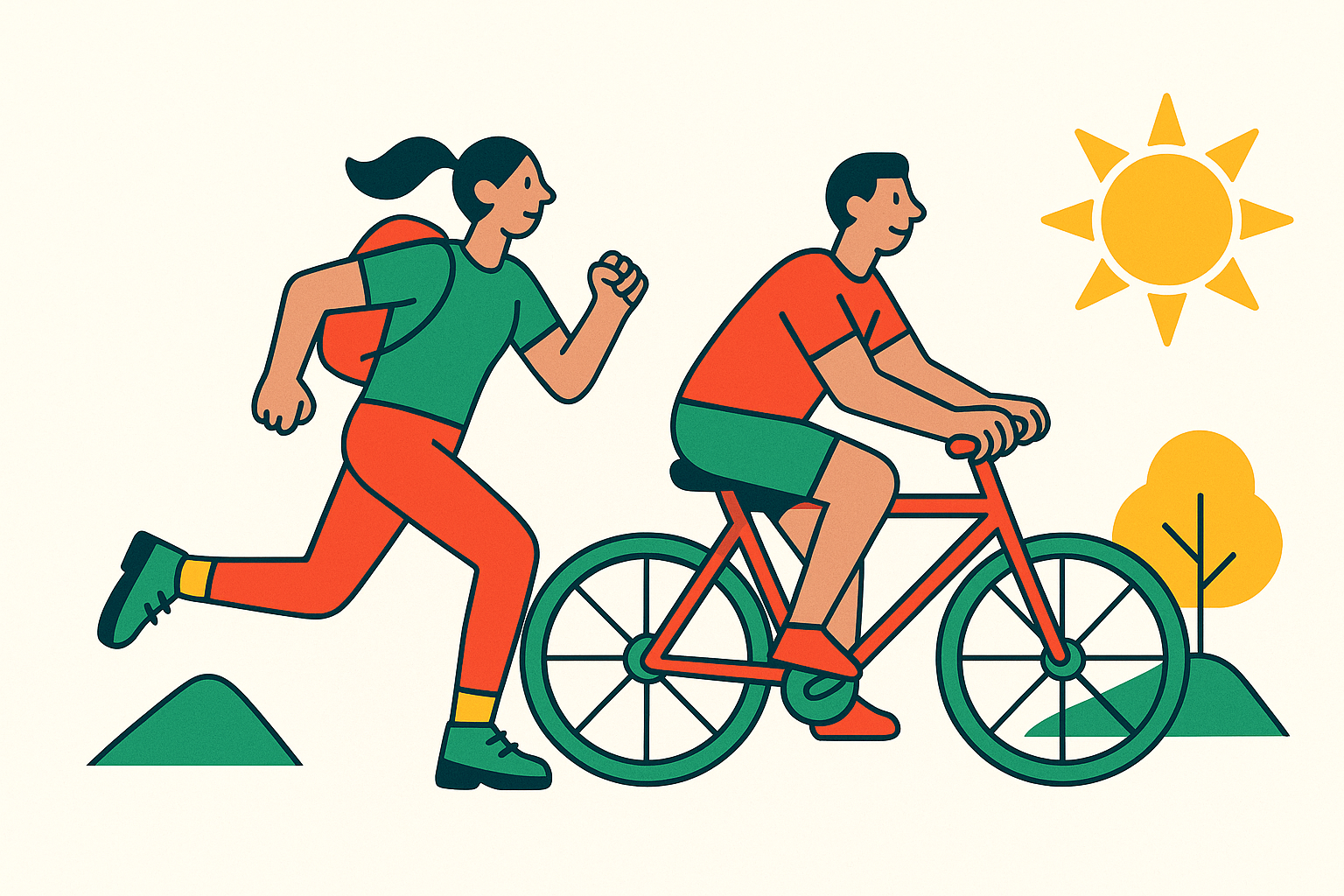
The best workout plan for a couple is the one they actually keep doing. That sounds obvious until you sit with what it means: a gym appointment feels like an obligation, and a date feels like something to look forward to. Frame the same physical activity as an adventure instead of a session and you show up more consistently, push harder without noticing, and come home in a better mood. The Journal of Health Psychology found that couples who exercise together report higher relationship satisfaction, better communication, and a stronger sense of feeling supported. The Health and Fitness Association puts the share of people who report mental health benefits from physical activity at 89%. Per The Knot's 2024 Relationship and Intimacy Survey, physical activities already rank fifth among the most popular date types for both dating and married couples. People are already moving in this direction. The trick is making it stick.
There is something that happens when two people exert themselves at the same time. Heart rates rise and fall in sync. Breathing patterns match. The body does not distinguish between "this person just helped me reach the top of a climb" and "this person is someone I can trust." It reads both signals the same way.
Researchers call one piece of this the misattribution of arousal. A racing pulse from physical effort gets unconsciously read as romantic excitement. The physical challenge and the attraction blur together. It is not manipulation. It is just how the body processes a shared experience when the stakes are mildly elevated.
Novelty amplifies everything. Research consistently shows that challenging or unfamiliar activities produce a measurable boost in romantic attraction and relationship quality beyond what routine walks or familiar outings deliver. The activity does not need to be extreme. It needs to feel like something you have not done a hundred times before.
A few things worth keeping in mind when choosing:
Novelty matters. New environments and light challenge do more for connection than familiar, low-effort outings.
Cooperation builds something specific. Activities where you depend on each other mirror the structure of a healthy relationship in a way that side-by-side treadmill runs simply do not.
Being outside together adds a layer. Research on long-term couples finds that shared time outdoors is valued for both the movement and the feeling of being connected to something larger than yourselves.
The choice of activity is not arbitrary. Novelty, mild challenge, and some form of cooperation are the ingredients that make movement feel bonding rather than burdensome.
Activities Where the Workout Hides Inside the Experience
The organizing principle here is simple: lead with what these activities feel like as dates, and let the fitness follow on its own.
Hiking
The destination does all the motivational work. A waterfall, a summit, a viewpoint at golden hour. Nobody drags themselves out of bed to burn calories. They go because there is something to see at the end.
Conversation flows naturally on a trail in a way it rarely does face-to-face across a restaurant table. There is no eye contact pressure. You are both looking ahead. That turns out to matter more than it sounds.
Flat hiking burns roughly 200–300 calories per hour. Uphill terrain with a pack can exceed 500, based on 2024 Adult Compendium of Physical Activities MET values. Trail difficulty is self-selecting, which means one partner being fitter than the other does not automatically ruin the plan.
Kayaking and Stand-Up Paddleboarding
Being on water reframes exertion as play. Neither of you is counting reps. You are navigating, looking around, trying not to tip over.
Kayaking burns somewhere between 375 and 475 calories per hour on average. It engages shoulders, arms, back, and core without either partner feeling like they wandered into a fitness class by accident.
Stand-up paddleboarding adds a balance challenge that produces a lot of falling, and falling together produces a lot of laughter. That is worth more than most people account for when planning a date. Rentals at most water access points keep both activities low-commitment for a first try.
Indoor Rock Climbing
The trust structure is built into the activity. One partner climbs, the other belays. Cooperation is not optional. It is the literal format.
Burns 400–550 calories per hour at low-to-moderate difficulty, outperforming recreational tennis and casual cycling per the 2024 Compendium. (Actual climbing represents only a portion of time spent in a gym, so effective hourly burn is lower than those numbers suggest. Worth knowing going in.)
Bouldering walls skip the harness and use thick padding instead, which lets both partners climb at the same time. If you are two people who prefer doing things in parallel rather than taking turns and watching, bouldering is the better format. Entry cost runs $20–30 per session including equipment, which makes it accessible for a one-off date before committing to anything.
Dancing
Latin styles, swing, even beginner ballroom. The learning curve is the date. You are not there to perform. You are there to fumble through something new together, which is a surprisingly good time.
Burns roughly 200–300 calories per hour, more for energetic styles. Beginner drop-in classes require no prior experience and handle mismatched fitness levels gracefully because coordination matters more than conditioning. Swing and step-based styles in particular have been gaining traction through 2025, and the energy they carry suits a date context well.
Theme Parks and Zoos
Disney park guests walk between 7 and 10 miles per day. That is tens of thousands of steps without framing a single one of them as exercise.
The zoo version is more accessible in cost and more repeatable. The movement credential is identical. This is the whole argument in its purest form: nobody goes to a theme park for the steps.
Cycling
A bike path ride covers ground and opens up conversation without demanding anything. A mid-ride stop for food reframes the whole outing as leisure. Intensity is self-selected, which makes cycling one of the more forgiving options for couples at different fitness levels.
Geocaching
An outdoor scavenger hunt with a built-in narrative. The search is the point. The walking is incidental. It is free to start, available almost everywhere, and cooperative by design, which suits couples who find head-to-head competition more stressful than fun.
Why Pickleball Has Become the Default Active Date for Couples Right Now
The numbers first, because they are genuinely hard to ignore.
In 2025, 24.3 million Americans played pickleball. That is a 22.8% year-over-year increase and a 171.8% jump over three years, per the SFIA 2026 Topline Participation Report. Up from roughly 4.2 million players in 2020. For the first time, pickleball surpassed tennis in total U.S. participation. 24.3 million players to tennis's 21.6 million.
The average player is 34.8 years old. Adults 25–34 make up 16.7% of all players. The sport's center of gravity is firmly millennial, the exact demographic most likely to be dating, partnered, and actively figuring out what to do on a Saturday.
There are now 82,613 courts across tens of thousands of locations in the U.S. as of 2025, with over 14,155 new courts added in a single year. Roughly 39 new courts every day. Access is rarely the obstacle, and many public courts are free.
But the growth numbers only explain why pickleball is everywhere. Here is why it works specifically as a couples activity:
The court is small. You are always close to your partner. Conversation happens naturally even mid-game.
Beginners can have fun on day one. The learning curve is short enough that someone who has never held a paddle is not miserable their first time out, which is unusual for racket sports.
It rewards communication over athleticism. Positioning and strategy matter more than raw fitness, so the smarter team can beat the more physically imposing one. The competition stays genuinely open.
The format is flexible. Doubles puts you on the same side, cooperating. Singles gives you a friendly head-to-head. You pick based on how competitive or collaborative you want the day to feel.
The social energy around a booming sport also matters. Trying pickleball in 2025 feels timely rather than effortful. There is built-in momentum, and that is worth something when you are trying to get someone off the couch on a Sunday morning.
Lower-Key Options When the Goal Is Connection Over Intensity
Not every weekend calls for a summit or a kayak. Some dates work better when movement is clearly secondary to fun and atmosphere. These still deliver more activity than dinner and a movie, and for couples where one partner is less sporty or less interested in fitness framing, meeting in the middle here is what consistency actually looks like.
Bowling
About 150–225 calories per hour. Not a calorie torcher. But bowling is a reliable social lubricant with zero fitness prerequisite. Scores on a screen give the date structure without pressure. It suits first dates, mixed-ability pairs, and low-energy weekends with equal grace.
Bar Games (Darts, Billiards, Shuffleboard)
Around 150–200 calories per hour. The point is not the burn. The point is that you are moving, competing playfully, and fully present with each other without a screen pulling your attention somewhere else. Works well as a second-half addition to a more physically active first part of the day.
Ice Skating and Roller Skating
The hand-holding is structurally built in. You are not holding hands because it seemed romantic. You are holding hands because one of you is about to fall. Burns a few hundred calories per hour. Roller skating fits the retro trend that has been gaining real traction through 2025.
Falling together produces laughter. And laughter does something for a relationship that a smooth, efficient workout simply cannot replicate.
Couples Yoga or Outdoor Fitness Classes
Pilates ranked as the number-one workout on ClassPass for the second consecutive year in 2025. Outdoor versions run in parks and public spaces and carry a social energy that feels nothing like a studio session.
The calorie burn is lower than most other activities here. That is fine. Attempting unfamiliar poses together, and looking ridiculous doing it, has its own bonding value that does not require a high intensity rating to count.
Volunteer dates fit here too. Habitat for Humanity builds, community cleanups, even yard work for a neighbor. Burns 200–400 calories per hour and adds a shared-purpose dimension that purely recreational activities do not carry.
How Competition and Cooperation Each Create Their Own Kind of Connection
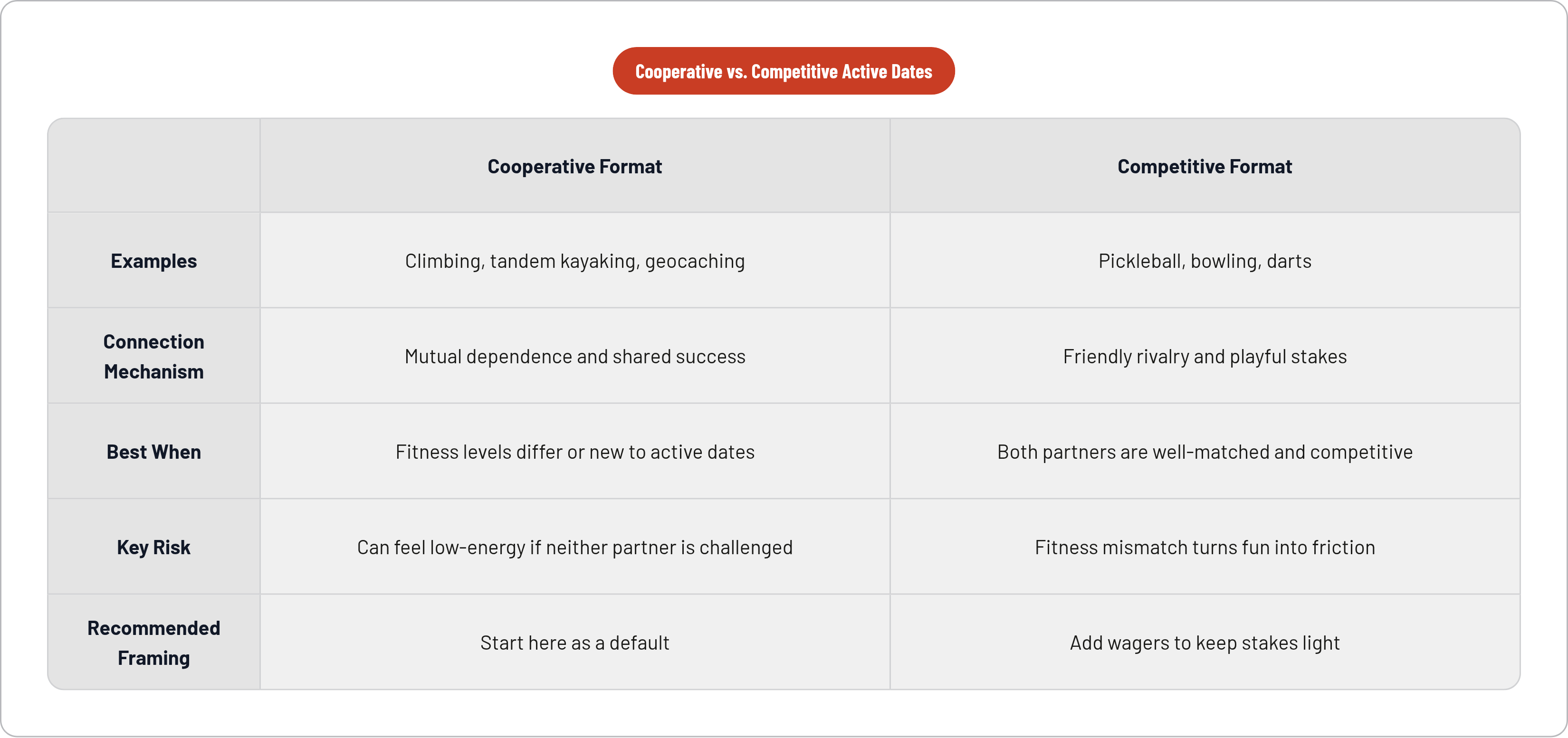
Not all active dates are emotionally equivalent. Some are cooperative by design: climbing, tandem kayaking, geocaching. Some are competitive: pickleball, bowling, darts. Picking the wrong format for a couple's dynamic can turn a fun plan into friction fast.
Cooperative activities build mutual dependence. One person's success requires the other's participation. That structure mirrors what relationship satisfaction research actually describes: the feeling of being needed, relied on, and effective for someone else. It is not subtle. You can feel it in the moment.
Competitive activities can strengthen connection, but only when both partners are reasonably matched and the stakes stay low. Friendly wagers help. Loser buys coffee. Winner picks the next date. That framing keeps the mood playful rather than pointed.
The risk is real though. When fitness levels or competitive instincts are significantly mismatched, winning and losing stops feeling fun for at least one person. That is the moment an active date becomes a source of tension instead of connection.
A simple way to think about it:
New to active dates together? Start cooperative.
One partner is significantly fitter? Choose scalable activities like tiered trail difficulty or beginner climbing routes, or go cooperative so the gap is less visible.
Both partners are competitive? Reserve head-to-head formats for activities where luck and skill overlap with fitness, so neither person feels physically outclassed.
Coming home annoyed at each other is the only outcome worse than skipping the date entirely.
Turning One Good Date into a Habit That Sticks
The consistency research is clear: partners who exercise together are more likely to maintain a routine over time. Accountability and shared investment reduce the friction of low-motivation days. You are less likely to bail when someone else is counting on you.
The practical failure mode is straightforward. A great active date stays a one-off because nobody books the next one. The date has to generate its own sequel, and that does not happen automatically.
A few low-structure approaches that actually work:
Rotate choice week to week. Each partner picks one Saturday per month. This distributes ownership and prevents one person from always feeling dragged along.
Keep a running record. A photo from each outing, a shared list of places tried. Visibility without a dashboard or a tracker.
Put a standing placeholder on the calendar. Even a rough one. That placeholder does more for consistency than any amount of elaborate planning.
Friendly wagers keep the momentum playful. Loser plans the next date. Winner picks the activity.
Of the many millions of U.S. adults who planned to set goals in 2025, a large majority focused on health and fitness. Most of those intentions fade without a social structure to sustain them. An active date routine is exactly that structure. It just happens to feel like something people actually want to do on a weekend.