Couples Yoga Routines for Beginners
Couples yoga deepens stretches and strengthens relationships through shared physical dependency.
Couples yoga has a reputation problem. Say the words out loud and most people picture either a resort brochure or an acrobatic circus act where someone is standing on their partner's head. Neither image is accurate, and neither is useful if you're two people who have never done yoga and are just looking for something to do together that isn't Netflix.
Here's the actual truth: couples yoga works for beginners not despite the fact that you're physically connected to another person, but because of it. The dependency is the point. It's what makes the poses accessible, what makes the stretches deeper and safer, and what makes the whole thing quietly, unexpectedly good for the relationship. You don't need flexibility. You don't need yoga experience — just a partner who will show up and lean into it with you. Literally.
What Physical Dependency in a Pose Actually Does for Two Beginners
When you're trying to fold forward alone as a beginner, your body fights you. Your hamstrings hit their limit, your back rounds, and you spend the whole pose arguing with your own nervous system. When you have a partner holding your wrists and offering gentle resistance, something different happens. Your muscles get a slow, gradual signal to release rather than a sudden demand to perform. You go deeper. You go safer. The partner isn't doing the work for you. They're giving your body a reason to stop bracing.
This is what partner resistance actually does:
It allows muscles to release gradually rather than being forced
It gives your body feedback it can trust, which replaces the flexibility you don't have yet
It distributes the load so neither person has to be "good" at the pose to get into it
There's also something happening in the nervous system that's worth knowing about. Stabilizing each other in a pose trains what's called the proprioceptive system. That's your body's ability to sense where it is in space. Better proprioception means better balance and posture over time, and you build it just by doing this, not by thinking about it.
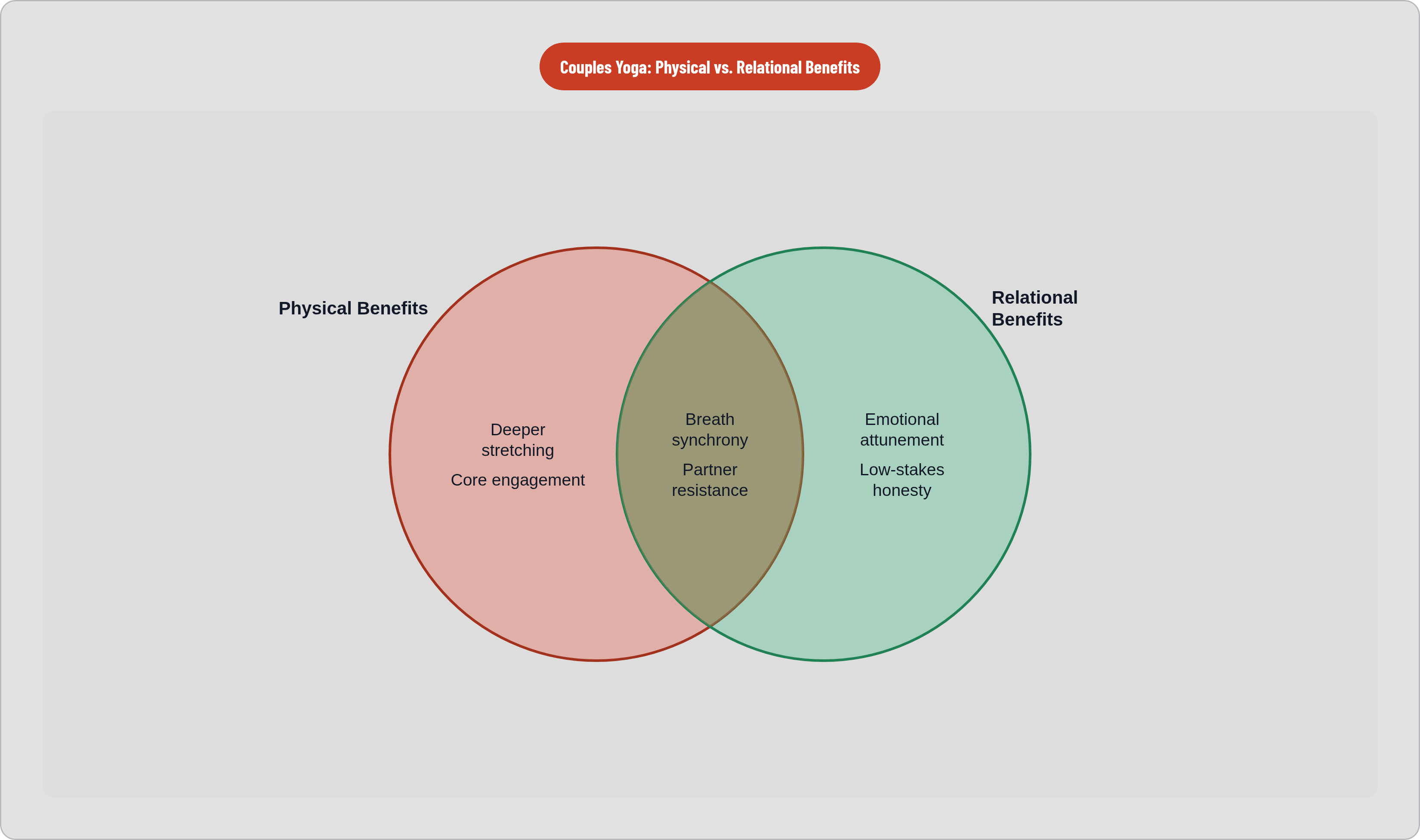
The coordinated breathing piece matters too. Breathing in sync with another person activates the parasympathetic nervous system. That's the branch that produces calm and steadiness, the opposite of the stress response. The physical mechanics of the practice reinforce the relational benefits. It's not accidental. It's baked into the structure.
The dependency that looks like a limitation is actually the whole mechanism. That's the thesis, made physical.
The Research on What Shared Physical Activity Does to a Relationship
A University of California, Davis study placed 32 couples near each other without any touching or talking. Just proximity. Their breathing naturally synchronized anyway. The effect was stronger in couples who reported higher relationship satisfaction and longer relationship duration.
That finding matters here because couples yoga doesn't just let that synchrony happen passively. It deliberately amplifies it. Coordinated breathing in shared poses accelerates what proximity alone begins.
The research adds up in other directions too:
Coordinated nonverbal movement increases felt empathy and what the British Psychological Society calls being "more affectively attuned." Mimicking your partner's movements is a measurable bonding mechanism.
A study of 128 couples found that practicing yoga together had a positive effect on relationship satisfaction, mindfulness, and emotional intelligence.
Touch from a romantic partner lowers the neural stress response more quickly than touch from anyone else. The physical contact built into partner poses is doing relational work that goes beyond the stretch.
Research on challenging new shared activities shows increases in relationship quality and romantic attraction. Learning something unfamiliar together amplifies the effect.
One honest note: most of these studies are small. The causal arrow between yoga and relationship quality is plausible and well-supported, but not definitively settled by the science. What's clear is the direction. Shared physical activity with your partner is good for you and good for the relationship. Couples yoga hits nearly every mechanism researchers think explains why.
Why Most Beginner Couples Should Start on the Floor
The best beginner poses are seated or lying down. No balance demands. No height. No one bearing anyone else's weight. Just two people on the ground, working together.
Starting on the floor does a few things at once. It removes the fear of falling, which is a real psychological barrier when you're new to this. It lets both people focus on breath and communication rather than trying not to tip over. And it turns out that body size differences between partners matter a lot less in floor-based poses than in anything standing or weight-bearing. That makes the "this is accessible" claim concrete, not just encouraging.
The progression logic is simple:
Floor poses build trust and body awareness
Standing poses add balance demands once you already know how each other moves
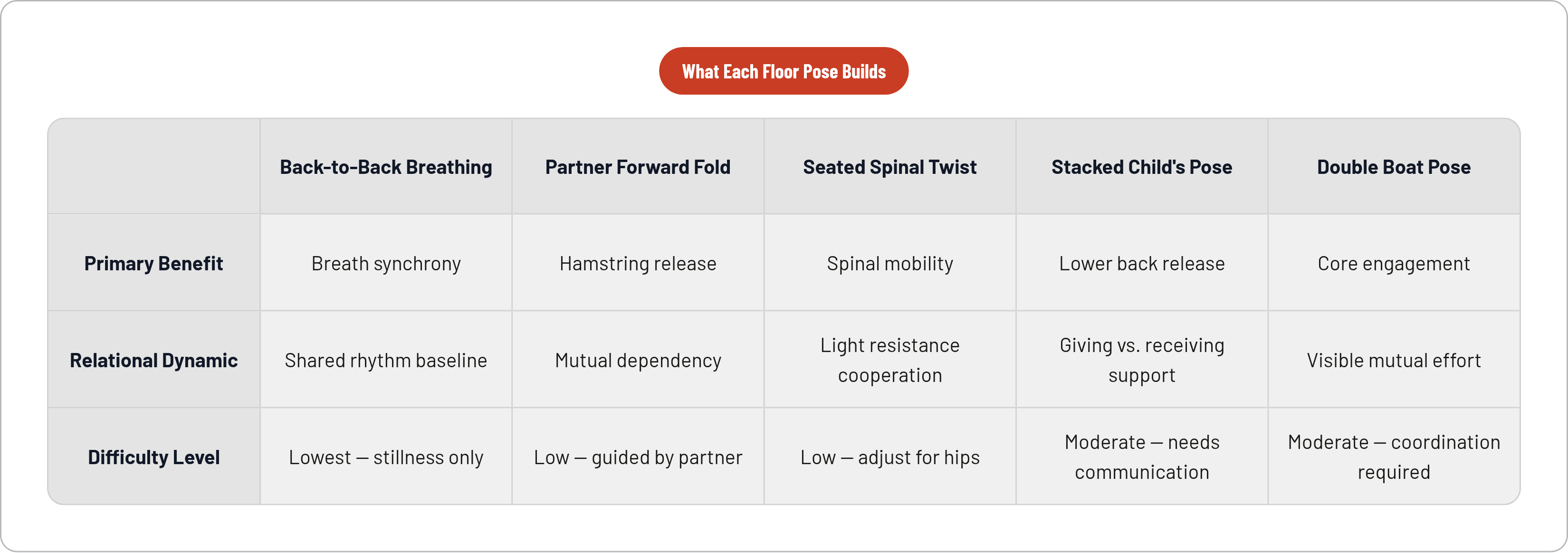
Think of it as learning the language before trying to have a complex conversation. The five floor poses below are ordered from least demanding to most. A couple can stop anywhere and still have completed something real.
Five Grounded Poses That Work for Any Beginner Pairing
Back-to-Back Seated Breathing
Sit upright with your spines touching. Hands rest on your knees. Breathe slowly through the nose, and try to feel your partner expand on the inhale behind you.
Do this for three to five minutes. Don't skip it.
This is the practice — not merely a warmup. It's activating the breath synchrony that the UC Davis research describes. It establishes a shared rhythm before anyone moves. Everything that comes after is easier because of this.
Partner Seated Forward Fold
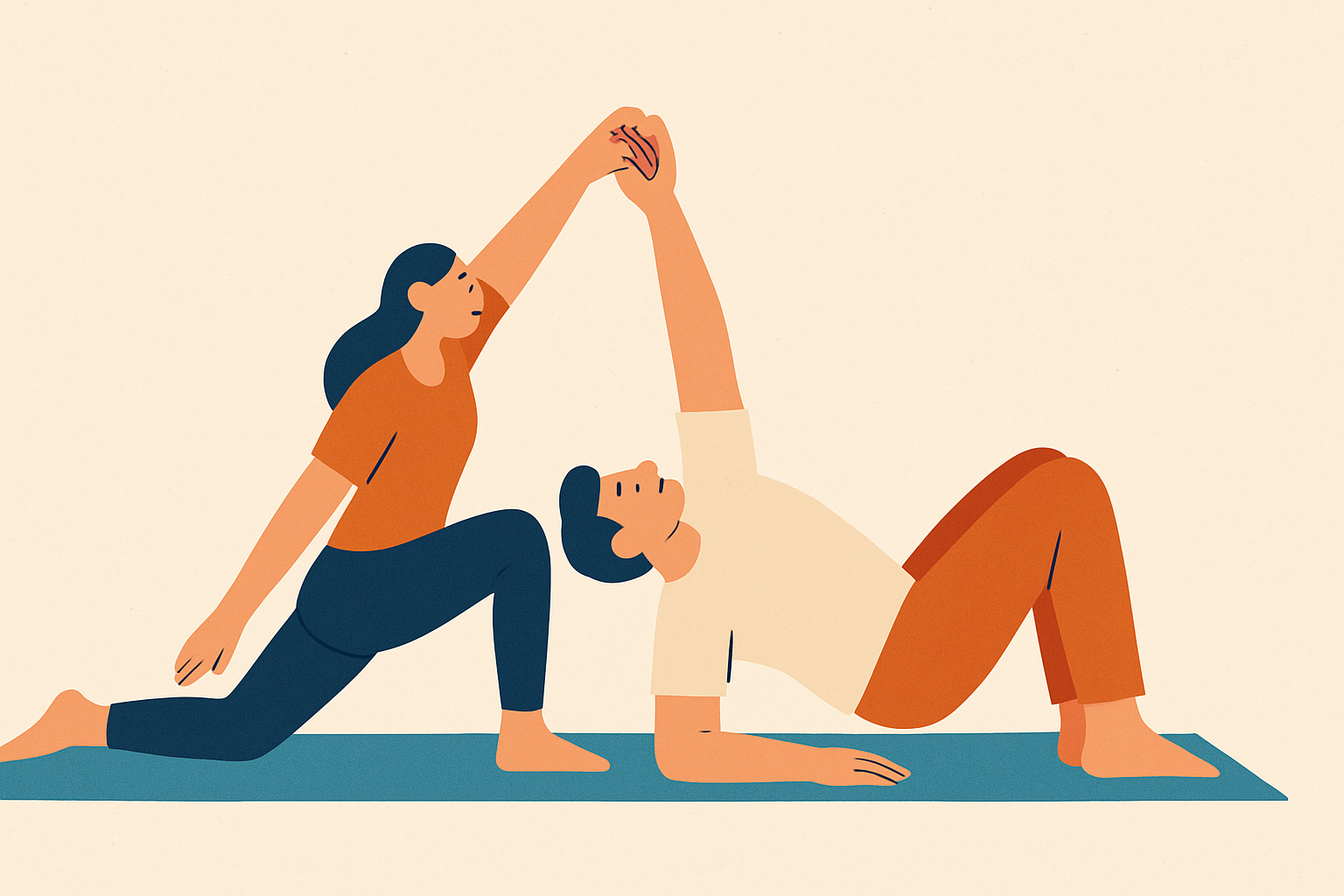
Sit facing each other with legs extended. Hold each other's wrists. One partner gently leans back while the other folds forward. Hold, breathe, then switch.
The breath cue: inhale to lengthen the spine, exhale to fold a little deeper. Your partner's resistance guides you. It does not force you. The cooperation is immediate and obvious. Neither person can do this pose without the other. That's the whole point.
Back-to-Back Seated Spinal Twist
Sit cross-legged, back-to-back, spines touching. Inhale to grow tall. Then twist, and use your partner's back as light resistance to deepen it gently. Hold five to eight breaths, then switch directions.
The physical benefits are real: spinal mobility, improved digestion, better posture. If cross-legged sitting is uncomfortable, extend one or both legs forward. No couple should skip this pose because of hip flexibility.
Stacked Child's Pose
One partner settles into child's pose. The second lies back across their lower back, slowly and with communication.
Hold about 60 seconds, breathing slowly. Both partners get lower back release at the same time, just from different angles. Then switch.
This pose is asymmetric by design. One person is giving support; the other is receiving it. That's a relational dynamic, not just a physical one, and most couples notice it.
Double Boat Pose (Navasana)
Sit facing each other, bend your knees, press the soles of your feet together, and grasp each other's hands or forearms. Slowly lean back while raising your feet together. Core engagement required.
The shared foot contact is what makes this possible. Without it, most beginners can't hold the pose. With it, they can. This is a natural first "challenge" pose. It requires real coordination and communication to get into and hold. It's a good endpoint for a first session because the effort is visible and the success is mutual.
Two Standing Poses That Add Balance Once the Basics Feel Solid
Partner Chair Pose (Back-to-Back Squat)
Stand back-to-back and lean into each other. Walk your feet out and lower together until you reach a seated position. Arms can stay out, rest on your thighs, or extend overhead if you want more challenge.
Hold briefly, then rise together. The timing of standing back up is where couples often laugh. That's fine. The pose works precisely because neither person can hold it alone. The mutual weight distribution is the mechanism.
Partner Tree Pose
Stand side by side. Raise your inside arms together toward the ceiling and press your palms together near shoulder height. Then lift your outside leg, bend the knee, and place the foot above the knee.
The partner contact replaces the solo stability work. Beginners who genuinely cannot hold tree pose alone can often hold it this way. That's not a modification. That's the pose working as designed. Switch sides so each partner gets the same support.
Both of these standing poses are natural places to notice progress. Come back to them after a few sessions and you'll feel the difference in your coordination, even if your flexibility hasn't changed at all.
How Communication Works Inside a Partner Pose — and Why It's Hard at First
Partner yoga requires real-time honesty. You have to tell your partner when a stretch is too deep, when you need to adjust, when you're ready to switch. These are small acts of communication that most couples don't practice in ordinary life — not because they're bad communicators, but because ordinary life doesn't create the specific situation where you need to say "that's too much" in a low-stakes, body-level way.
The poses create exactly that situation. They're low stakes. Nothing is on the line. But the communication is real.
Nonverbal communication matters just as much here. Matching breath, feeling a partner's resistance, reading when they're uncomfortable. That attunement happens through the body. You don't have to narrate everything.
One practical agreement before you start: either partner can pause, adjust, or skip any pose, no explanation needed. That one sentence removes the social pressure that turns discomfort into silence, which is the opposite of what partner yoga is supposed to do.
Missing a cue or losing your balance isn't failure. It's information. The right response is to reset and try again rather than push through.
Building a Short Repeatable Session Rather Than a Perfect Routine
A complete beginner session can run 20 to 30 minutes. Back-to-back breathing to open. Two or three floor poses. One standing pose. A few minutes of rest back-to-back to close. That's it. That's a session.
The sequence doesn't need to change week to week. Returning to the same poses lets you notice your coordination improving, which is more motivating for beginners than novelty. You don't need to feel like you're advancing through a curriculum — just that you're getting better at something together.
A few principles that actually hold:
Consistency beats ambition. A short session both partners finish is worth more than a longer one that gets skipped because one person isn't feeling it.
Once or twice a week is enough. Daily practice is not the goal at the beginner stage.
The accountability is built into the format. This practice literally cannot happen without both people showing up. That's not a bug.
A quick check-in after the session about how it felt, or some small shared thing you do afterward, reinforces the habit without adding pressure. The celebration of showing up matters as much as what the poses accomplished.
The poses will get easier over time. Your flexibility will improve. Your balance will too. But the actual thing being built here is the habit of doing something physical, communicative, and cooperative together. That habit is harder to develop than any of the poses. And it's worth considerably more.