Home Gym Setup for Two People with One Budget
Shared home gyms pay for themselves faster and need less compromise than you'd expect.
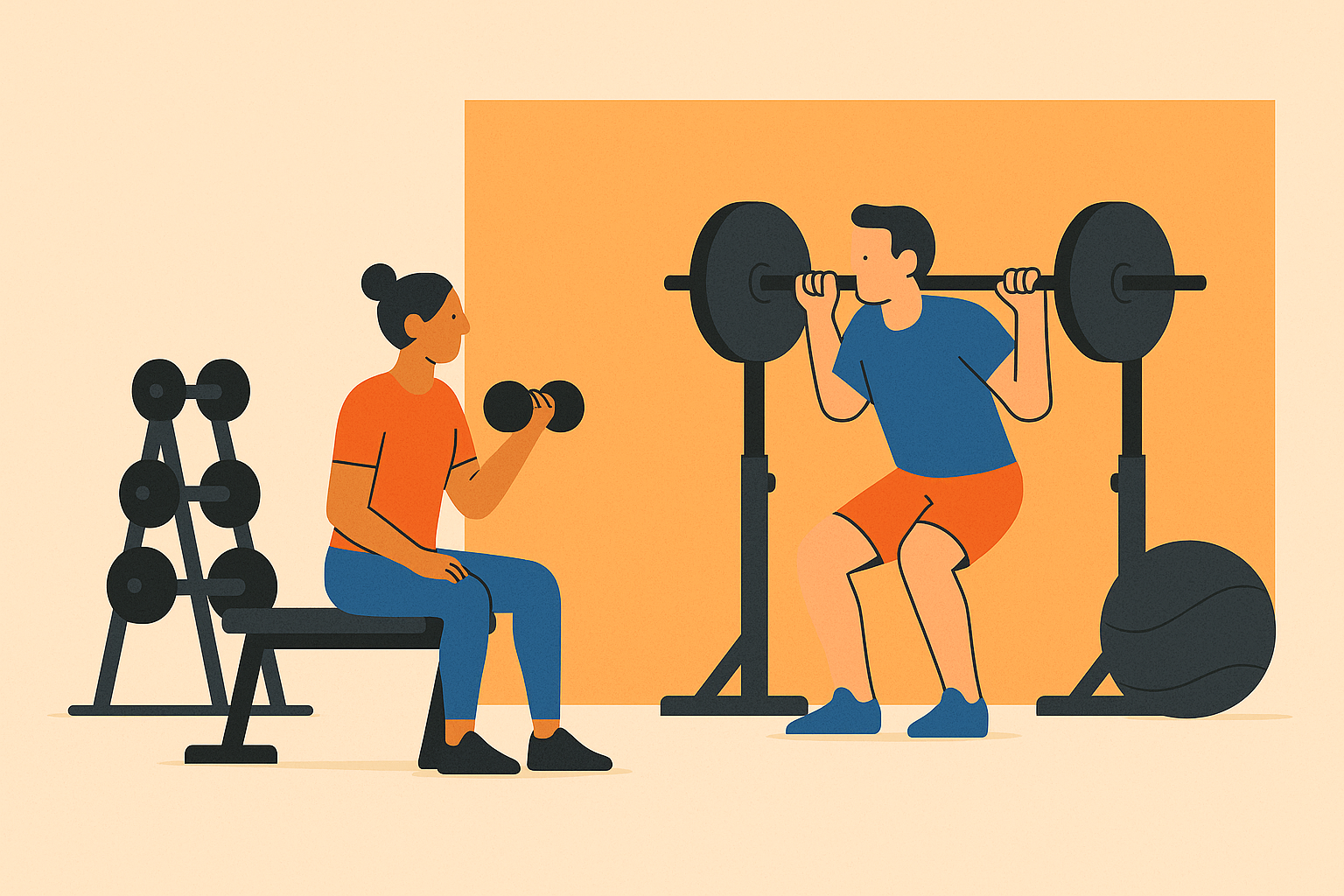
Your home gym is either the best financial decision you and your partner ever make together, or it becomes a very expensive coat rack. The difference is almost entirely in how you plan it. Two people sharing one budget for a home gym sounds like it should be harder than going solo. It's actually the opposite. The math works better, the accountability is built in, and the equipment choices simplify fast when you ask the right questions up front. The whole thing hinges on one framing shift: a home gym built for two isn't splitting a compromise. It's converting a recurring cost into a shared asset that you own, and that ownership is the whole point.
Here's the honest version of how this works, what it costs, and what makes it stick.
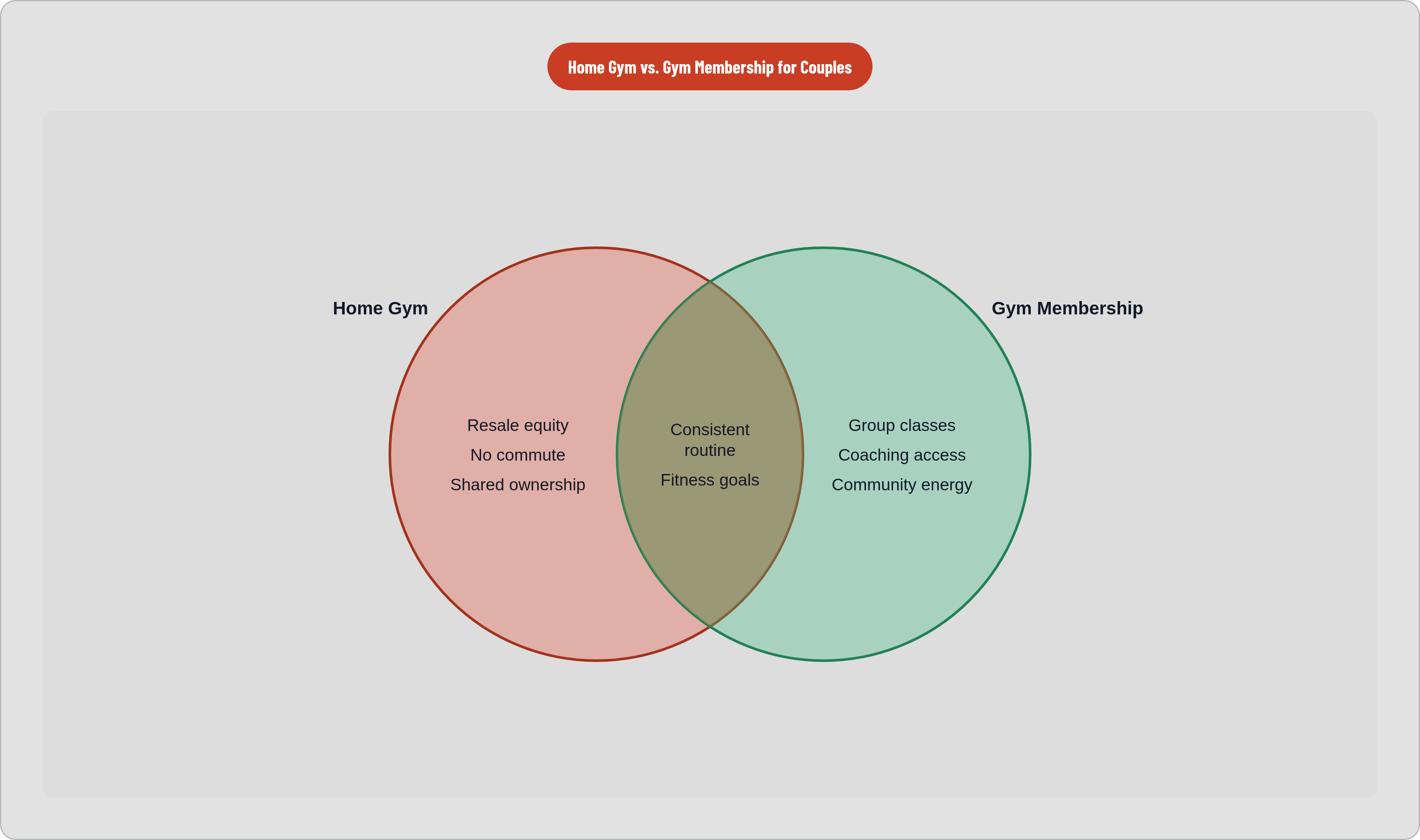
Before jumping into the numbers, it's worth naming when a membership still wins. If one of you is brand new to training and wants coaching, a gym makes sense. If either of you runs on the energy of group classes and community, a home gym won't replicate that. And if you're genuinely space-constrained, the math changes. Those are real situations. But for most couples who already have a routine, some experience, and a spare room or garage corner? The case for a shared home gym is hard to argue against once you actually run the numbers.
How long it actually takes a shared home gym to pay for itself
The average U.S. gym membership hit $69 per month in 2024, up from $65 in 2023. That's a 6.2% year-over-year increase, outpacing general inflation. Two memberships at a mid-tier gym runs $1,400 to $1,800 per year combined, before you count commuting time and costs. Once you factor those in, the true all-in cost per person climbs to somewhere between $700 and $1,600 annually. Double that for two people and the number becomes genuinely hard to ignore.
For one person, a foundational home gym setup runs around $2,837. At roughly $828 per year in membership savings, break-even lands somewhere in the 2.5 to 3.5 year range.
For two people, the break-even point compresses significantly. Same equipment cost. Two memberships cancelled. The annual savings roughly double, so the denominator grows without the numerator changing. Over a long enough horizon, home gym owners save between $7,050 and $37,939 compared to gym memberships, depending on membership tier. For two users, that range shifts upward further.
Most people also miss the resale value point. A quality barbell you bought for $300 might sell for $200 five years later. A gym membership has zero resale value. The equity is real, even if it's modest.
Then there's time. A home gym saves an estimated two to four hours per week versus training at a commercial gym. No commute, no waiting for equipment, no hunting for parking. For two people, that's a meaningful combined return on top of the financial one.
One honest caveat: the math only works if both people actually use the space. Equipment that goes unused is a sunk cost, not a savings.
What "one budget" actually means when two people are making decisions together
The real planning problem isn't money. It's alignment. One person wants to build strength. The other wants cardio, or mobility, or something in between. Those different goals can pull a shared budget toward redundant or incompatible equipment fast.
The limited budget is actually a productive constraint here. It forces prioritization toward equipment that genuinely serves both people. That's a feature, not a failure.
Before you spend anything, settle these questions:
- What movements do both of you actually do, or want to do?
- Where do your training styles overlap? If you both lift, a barbell and rack are worth the investment. If one of you lifts and the other does yoga, carve out floor space before buying more iron.
- What's the available space, and can you define zones within it?
- Is simultaneous use a priority, or do you typically train at different times?
The overlap principle is simple. Equipment that serves both people at their different ability levels, adjustable, multi-function, scalable, earns more budget share than anything single-purpose. A shared setup built around that principle creates more value than two separate, half-funded setups ever could.
The equipment tier that fits most two-person budgets without major sacrifice
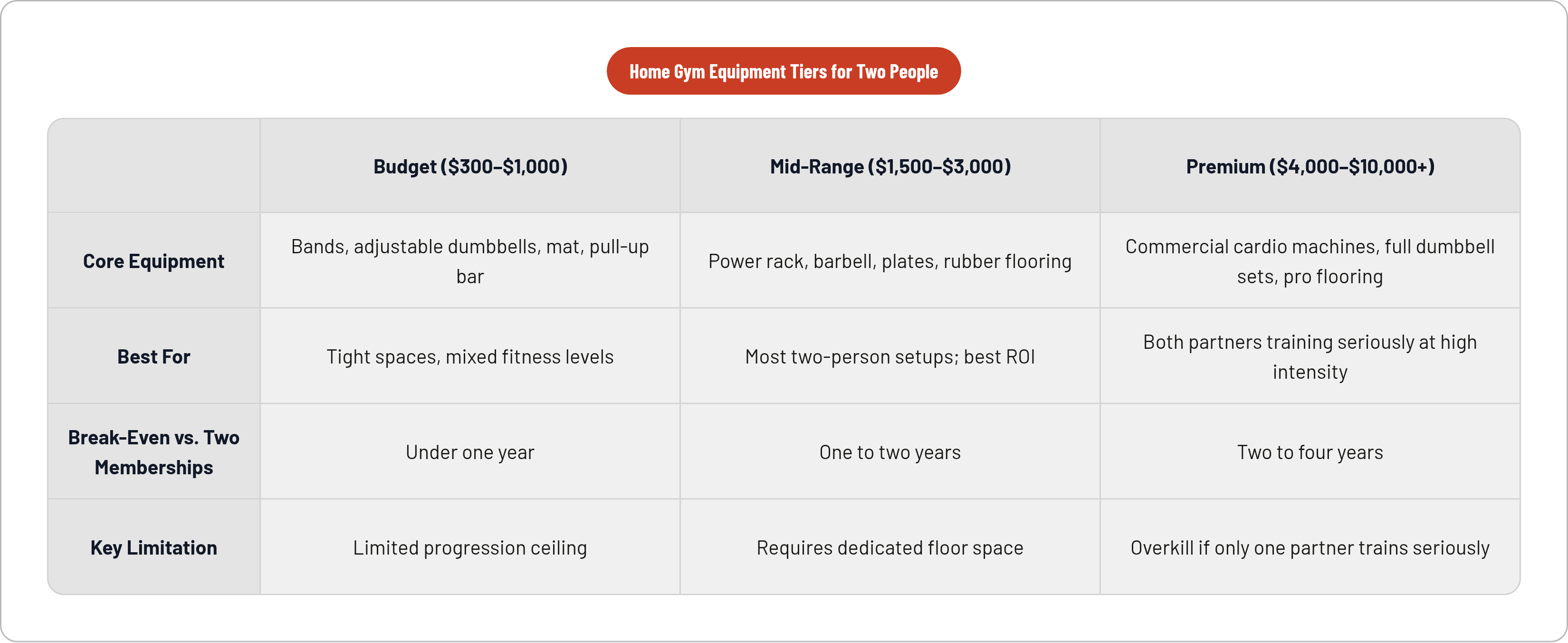
Home gym setups run from $500 to $5,000 or more for equipment alone. Full build-outs including space conversion average around $7,750, with a realistic range of $2,150 to $13,750. The tier you land in should match both your training needs and your timeline for break-even.
Budget tier ($300–$1,000): Resistance bands, adjustable dumbbells, a mat, and a pull-up bar. Genuinely functional for two people at different fitness levels, especially if space is tight. Not glamorous. Not limiting either.
Mid-range tier ($1,500–$3,000): This is where most two-person setups find the best return on investment. You're adding a power rack, barbell with plates, and rubber flooring. This range compares favorably to one to two years of two gym memberships, and it covers the core movements both people are most likely to need.
Premium tier ($4,000–$10,000+): Commercial-grade cardio machines, full dumbbell sets, professional flooring. Justified if both of you train seriously and would otherwise hold premium memberships. If that's not both of you, it's probably more gym than you need.
A few hidden costs catch shared setups off guard:
- Rubber floor tiles: $1.50 to $3 per square foot. A 10x10 area runs $150 to $300.
- Mirror installation: $250 to $500 depending on size.
- Ongoing maintenance: budget $100 to $300 per year.
Spend advice from someone who's seen plenty of people do this in the wrong order: prioritize the barbell and squat rack over everything else. These are the pieces where quality matters most. Accessories and secondary items can be upgraded later. That secondary treadmill can wait.
The adjustable dumbbell decision that defines most two-person setups
This decision matters more in a shared setup than most people realize. Two people at different strength levels need a wide weight range. Fixed sets either run out of range or run out of room.
The space math is stark. A pair of adjustable dumbbells occupies about two square feet. A 150 lb fixed set with a rack takes six to eight square feet. In a garage corner or spare bedroom, that difference matters.
The cost math also favors adjustables. A 5 to 50 lb fixed rubber hex set costs roughly $550, plus a storage rack from around $65. An adjustable pair covering a similar range runs $375 to $450.
According to data from the r/homegym community, 68% of home gym owners with limited space choose adjustable over fixed. The Bowflex 552 is the single most-recommended model in that community.
The honest tradeoff: adjustables require re-dialing between sets. Fine for straight sets. Frustrating for drop sets or high-intensity circuits, especially when two people need different weights at the same time.
If simultaneous use matters to both of you, two pairs of budget adjustables or a small fixed set for one person paired with an adjustable set for the other may serve better than one premium pair.
One safety note worth including: the original Bowflex SelectTech 1090 was recalled in 2025 due to plates dislodging during use. Owners may be eligible for a refund or replacement per the Consumer Product Safety Commission. Check that before buying used.
For current two-person setups, three models stand out:
- REP x PÉPIN Fast Series (5–100 lbs): Top-rated overall for range and build quality. A strong pick if both people plan to progress seriously.
- Bowflex Results Series 1090: The updated replacement for the recalled model. Wide range, reliable mechanism.
- PowerBlock Pro 100 EXP: Modular and expandable. You can add weight later as both of you get stronger, which is a real advantage in a shared setup.
Building around a power rack when both people want to train seriously
The rack is the shared foundation. Barbell squats, bench press, overhead press, pull-ups. These are movements both people are most likely to want, regardless of differing goals. A rack doesn't assume you train the same way. It just gives both of you a home base.
The entry point is lower than most people expect. Models like the REP PR-1100 and Titan T-3 Squat Stand bring a quality rack within reach without a premium price tag. A budget rack typically includes a 700 lb weight capacity, a pull-up arch overhead, and compatibility with attachments like a lat pulldown, low row, and dip station. The rack grows with the gym, which matters when two people are at different stages of training.
Barbell cost runs $100 to $300 for a solid entry-level bar. Weight plates run $1 to $3 per pound. Plan a combined starter plate budget and add more over time.
Pairing the rack with an adjustable bench rounds out the core setup. The REP AB-3000 at $329 is a well-regarded mid-range pick that transitions smoothly between flat, incline, and decline. That flexibility matters when two people run different programs on the same bench.
One alternative worth comparing: dual-stack machines like the Body-Solid G9S let two people train at the same time. If your schedules overlap heavily and simultaneous training is the priority over programming flexibility, that path is worth running the numbers on before committing to the rack-plus-bench route.
Designing the space so two people can actually use it at the same time
Most home gym guides are written for one person. Two people training simultaneously need movement clearance, equipment access, and some sense of defined zones. This doesn't require a huge space. It requires intention.
Zone logic for mixed-goal households:
- Strength zone: Squat rack, bench, barbell, and plates. Anchor this to one wall or corner.
- Cardio / conditioning zone: Treadmill, rower, air bike, or jump rope. Tuck this into the opposite corner or along a wall.
- Open floor zone: For stretching, mobility, yoga, and bodyweight work. This is the most undervalued square footage in a shared gym. Protect it.
Resistance bands earn more space in a two-person gym than their price suggests. They run $10 to $60, don't require a dedicated zone, substitute for weights in dozens of movements, and let one person work while the other uses the rack. They're a surprisingly good two-person tool.
Flooring is a two-person investment. Rubber tiles at $1.50 to $3 per square foot protect the floor, reduce noise, and define zones naturally. Budget for this early rather than treating it as an afterthought. It shapes how the whole space feels.
Before buying anything, run this test: map out what each person would be doing during a shared session. If both of you reach for the same piece of equipment at the same time, reconfigure before spending. The simultaneous use bottleneck is easier to solve on paper than after the equipment is already bolted down.
On mirrors: beyond aesthetics, they help both people check form without a spotter. Professional installation runs $250 to $500. A practical addition if budget allows after the essentials are covered.
How shared accountability turns a shared gym into a gym both people keep using
The financial case only holds if both people show up. Equipment that one person uses and the other ignores is a $2,000 monument to good intentions. This is the part of the home gym conversation that doesn't get enough attention, because it's not about equipment. It's about behavior.
What makes a shared space easier to return to than a solo gym:
- The friction of commute and schedule coordination disappears. Showing up becomes a shorter decision.
- Training alongside someone, even doing completely different workouts, creates low-pressure accountability. You're not each other's coaches. You're just each other's reason to be there.
- A shared goal gives both people a reason to be in the space, whether that's finishing the setup, hitting a milestone, or just maintaining a streak.
Simple shared habits that outlast motivation:
- Consistent days and times reduce the "do we train today?" negotiation. Remove the decision. Just go on Tuesday, Thursday, and Saturday. Done.
- A short shared warm-up or cool-down, even if the workouts diverge completely in the middle, keeps the gym a connected space rather than two isolated routines sharing a room.
- Celebrate showing up, not just performance. This matters more early on than tracking personal records.
For tracking, apps or simple shared logs that make both people's consistency visible to each other work well. Friendly wagers or small rewards tied to weekly goals, rather than daily metrics, tend to outlast the ones built around perfect performance.
The setup's real return isn't just financial. A home gym built for two that both people keep using doesn't just save money over two memberships. It builds a habit that's harder to drop because it's shared. That durability is worth more than any single piece of equipment in the room.