Running Together When One Partner Is Faster
Planning beats pace: couples who structure their runs stay together.

Most couples who run together don't quit because of the pace gap. They quit because nobody planned around it, and then one person felt like a burden and the other felt like they were babysitting, and eventually Tuesday mornings became easier to skip.
The research on this is not subtle. According to American Council on Exercise data from 2025, 94 percent of couples who exercise together report improved relationship satisfaction. Among couples who work out separately, that number is 67 percent. That's not a rounding error. That's a genuinely different outcome, and the only variable is whether they went together.
There's more. A peer-reviewed study from 2020 found that couples who exercised together reported greater health satisfaction and fewer health problems than those who didn't, even after controlling for diet, sleep, and sedentary behavior. And research on couples doing physically challenging activities together, not just sitting on adjacent treadmills, shows measurably higher relationship quality than those doing low-key, side-by-side stuff. The shared difficulty is doing something. Running the same cold route on a Tuesday morning is not the same thing as being near each other at the gym.
So the stakes here are real. Pace logistics are not just a training problem. They're a relationship problem, and a solvable one. Everything below is about how.
Why Slowing Down Is Not a Wasted Workout for the Faster Runner
Faster runners tend to feel like slowing down for a partner is giving something up. It isn't. That framing just means they haven't thought about how training actually works.
Elite endurance coaches use something called the polarized training model. About 80 percent of training volume happens at low intensity. Twenty percent is hard. That ratio consistently outperforms the "push moderately every day" approach that most recreational runners default to. Which means a lot of your runs are supposed to be easy anyway.
Easy runs are not junk miles. They build mitochondria, develop capillary density, and train your body to burn fat efficiently. That aerobic base is what your hard days draw on. A slow run isn't skipping training. It's doing a different part of it.
There's also the recovery angle. Light movement at low intensity clears metabolic waste and reduces soreness more effectively than sitting still. A slow run with your partner is not a rest day. It's a productive one that also gets you out the door with someone you like.
The concrete reality check: elite Kenyan marathoners who can sustain sub-five-minute pace for 26.2 miles run their recovery days slower than nine minutes per mile. Molly Seidel, an Olympic marathon medalist capable of 5:30 race pace, logs easy runs around 8:30. That's over three minutes per mile slower than what she races at.
If the people who run for a living are building slow days into their weeks on purpose, slowing down for a partner isn't a concession. It's just Tuesday.
The practical target: heart rate below 65 to 70 percent of max. If you can't talk in full sentences without stopping mid-breath, you're running too hard for a recovery day anyway.
How Running With a Faster Partner Actually Helps the Slower Runner Go Longer
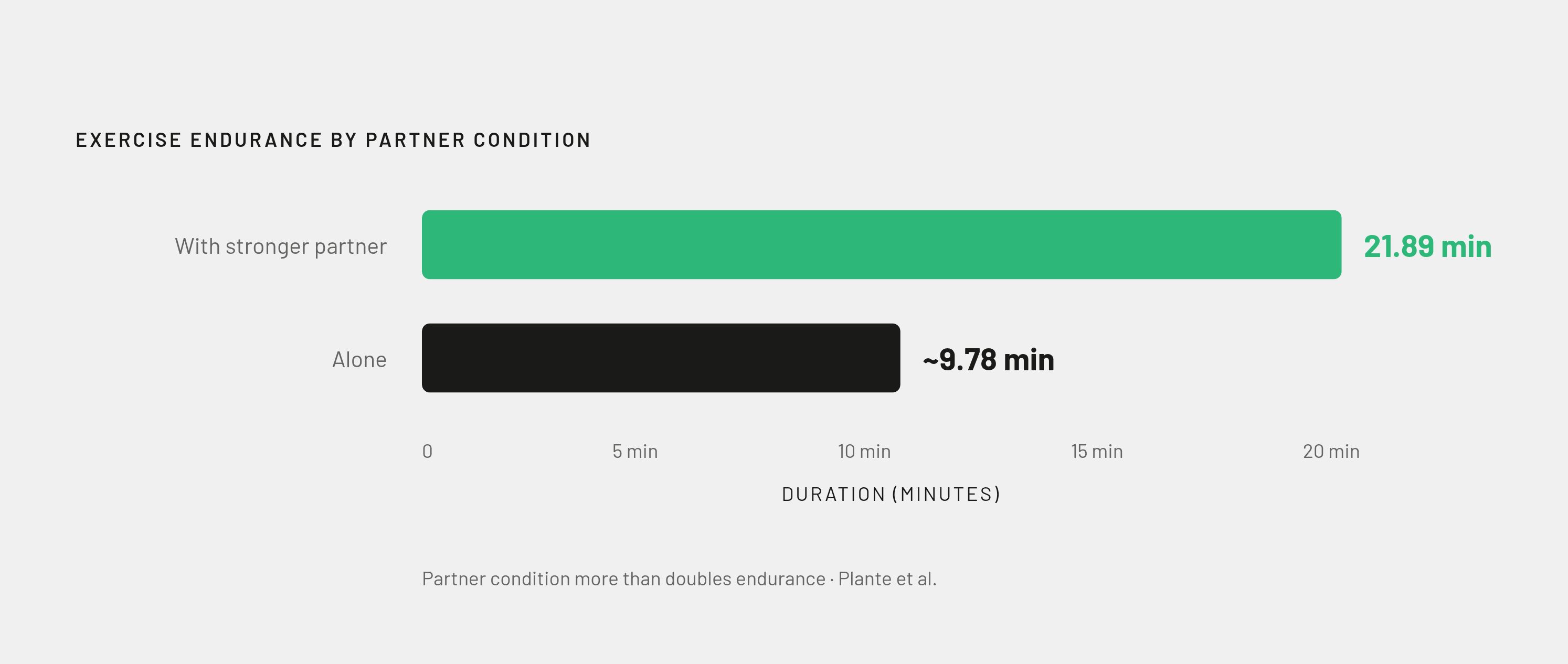
There is a documented psychological phenomenon called the Köhler effect. In group or partner tasks, the less capable person works harder and lasts longer than they would alone. Not because they're being dragged. Because quitting feels different when someone is right there.
A key study on this found that participants paired with a more capable partner lasted 21.89 minutes on an aerobic task. Participants who exercised alone lasted less than half that. The effect held across multiple sessions. It wasn't novelty.
Similar patterns showed up in swimming and track. Weaker group members gained the most when they moved from solo to group settings. A 2012 Michigan State University study published in the Annals of Behavioral Medicine confirmed the effect on aerobic tasks with 58 female participants over time.
What this actually means:
The slower runner doesn't need the faster one to set their pace.
Just having a stronger partner present raises how long they'll push.
The mechanism is motivational. The slower runner digs deeper because stopping feels like more of a choice when someone else is still moving.
One honest caveat: the Köhler effect works when the gap feels manageable and the dynamic feels collaborative. If the faster runner is visibly antsy, checking their watch constantly, or looping back with the body language of someone waiting for a bus, the effect reverses. The slower runner stops feeling like a teammate and starts feeling like a problem. That's fixable with structure, which is what the next section is about.
The Pacer Anxiety Problem and Why Pressure Ruins the Run for Everyone
In 1898, a researcher named Norman Triplett found that cyclists rode faster with a pacer alongside them than alone. Social facilitation. Being accompanied raises performance. That part is well established.
But the effect flips under specific conditions, and those conditions show up constantly in couples running together.
A study of 1,600-meter runners found that athletes assigned a personalized pacesetter reported higher pre-run anxiety than those pacing themselves. Their finishing times didn't improve. The pacer created pressure without producing results. Why? Because falling behind a pacer is a visible failure. Easing off your own internal pace is a private adjustment. The external standard converts effort into performance.
This plays out in couples constantly. The faster runner monitors splits. The slower runner is now being evaluated. Conversation stops. Anxiety goes up. The run starts to feel like a test they didn't sign up for. Then they start finding reasons not to go.
Any structure that actually works has to remove the performance pressure. Not manage it. Remove it. The faster runner's job is not to pace the slower runner. Their job is to show up and let the run happen around them.
Structures That Let Both Partners Run Their Own Run While Still Running Together
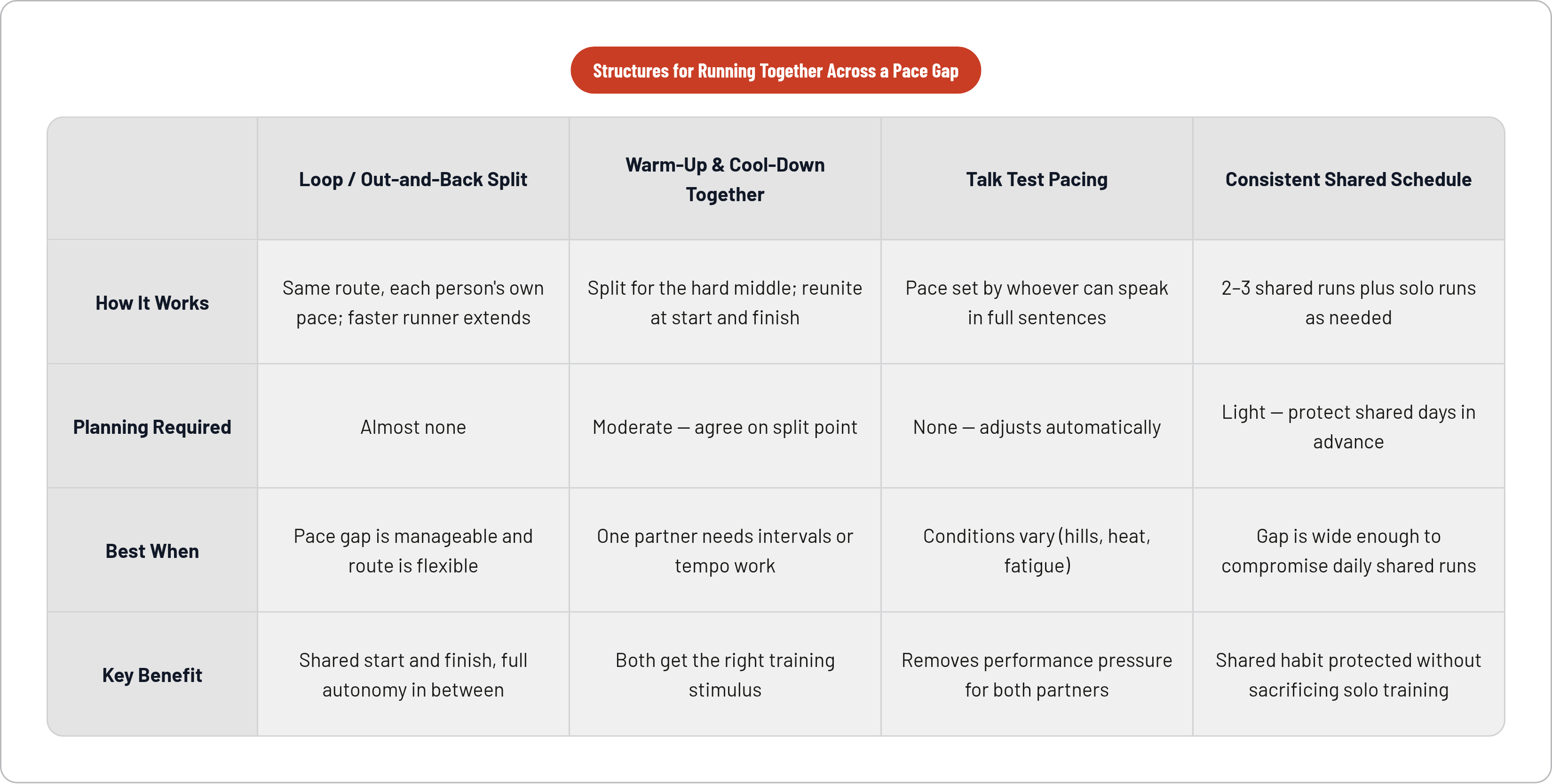
There is no single method that works for every couple. The goal is to find something both people find fair enough to repeat. These are the formats that hold up.
The loop or out-and-back split. Both run the same route at their own pace. The faster runner adds a loop, a short extension, or turns around early. Both finish at the same place. This one requires almost no planning. No watch coordination, no pacing agreement. Just a starting point and an ending point.
Warm-up and cool-down together, middle separate. Run together for the first and last segment. Split for the harder middle. The faster runner does intervals or tempo work. The slower runner runs steady. Both get the training stimulus they need. The run still starts and ends shared, which is the part that matters most for the habit.
Training for the same race on separate schedules. Sign up for the same event. Most training happens independently. You connect on how the long run went, what's hard, what's clicking. Race day is the shared experience you've both been building toward. This works well when the pace gap is wide enough that running together daily would compromise both people's training.
The talk test as a pace regulator. On easy shared runs, set the pace by whoever can speak in complete sentences without stopping to breathe. Research consistently links comfortable speech to exercise intensity near the ventilatory threshold, so this is physiologically valid, not just polite. The practical upside: it takes the decision out of both partners' hands. Nobody is slowing the other one down. The conversation is setting the pace. It adjusts automatically for hills, heat, and how tired everyone is.
A consistent shared schedule with room for solo runs. Two to three shared runs per week with additional solo runs as needed. The shared runs become protected. The solo runs let each person train without compromising the habit of going together. Both can exist at the same time without conflict.
The Conversation to Have Before the Run, Not During It
Most mid-run friction comes from the same place. Both people had different expectations, neither said anything, and then it surfaced at mile two when nobody wanted to deal with it.
Before you leave the door, name three things:
What kind of run is this? Easy, structured, long?
Are we staying together, or splitting somewhere?
What does each person need for this to feel like a good run?
That last question is the one people skip. For one person, a good run means they pushed. For the other, it means they finished without feeling humiliated. If those are both unspoken going in, the run is set up for conflict before you've left the driveway.
The standard worth aiming for: the slower runner should be able to say they're tired, ask to slow down, or cut the route short without having to justify it. If that kind of honesty feels uncomfortable between two people who run together regularly, that discomfort is the real problem.
One other thing: pace data on a shared screen brings back exactly the evaluation pressure the pacer anxiety research describes. Some couples use a shared tracking app to log workouts separately while still seeing each other's consistency rather than head-to-head splits. If one partner is chasing segment times and the other is just trying to finish, they're running different runs inside the same route. That's fine when both people know it. It's a problem when only one does.
After the run: acknowledge what went well. You went. You finished together. You had a conversation. Skip the splits.
How Shared Running Builds a Habit That Solo Training Rarely Does
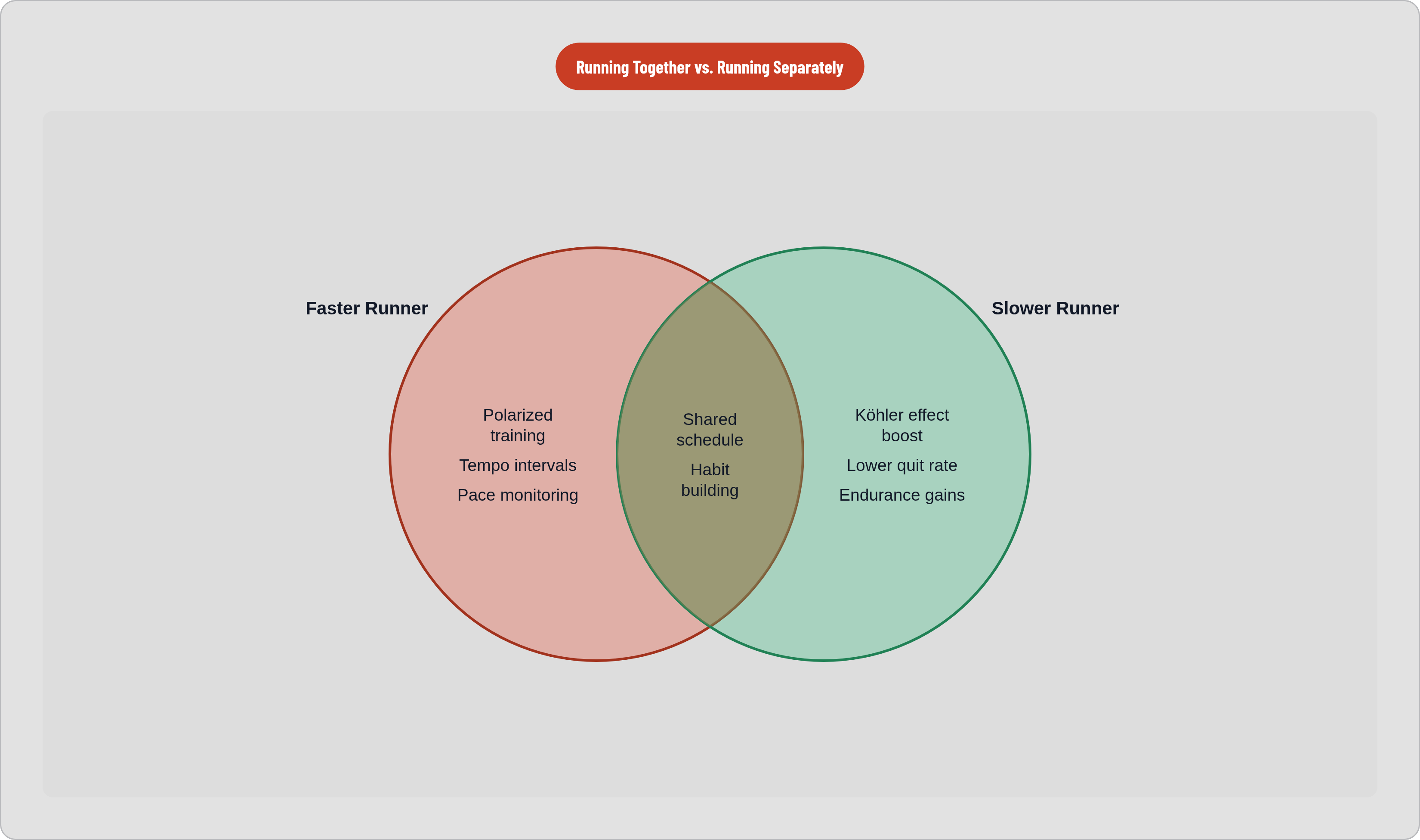
A run that both partners finish wanting to do again next week is more valuable than a perfect workout that either person quietly dreads repeating. This sounds obvious. It is also the thing that gets lost every time the faster runner pushes the pace a little and the slower runner says nothing.
Consistency is the point. A majority of couples who run together report that it brought them closer. Not because the runs were fast. Because they kept going.
There's also something that doesn't get talked about enough, which is that showing up for runs builds a pattern of showing up. For early mornings. For hard days. For each other. That pattern doesn't stay contained to running.
The pace gap is not a problem that needs fixing. It's a condition that needs designing around. The faster runner gets a legitimate recovery run and a reason to get out the door. The slower runner gets the Köhler effect and a partner who makes quitting feel like more of a decision. Both get the run.
That's the whole design problem. It turns out it's not that complicated.