Long Distance Couples Who Want to Follow the Same Workout Program in Real Time
Long-distance couples need the same workout plan and real-time accountability to stay consistent.
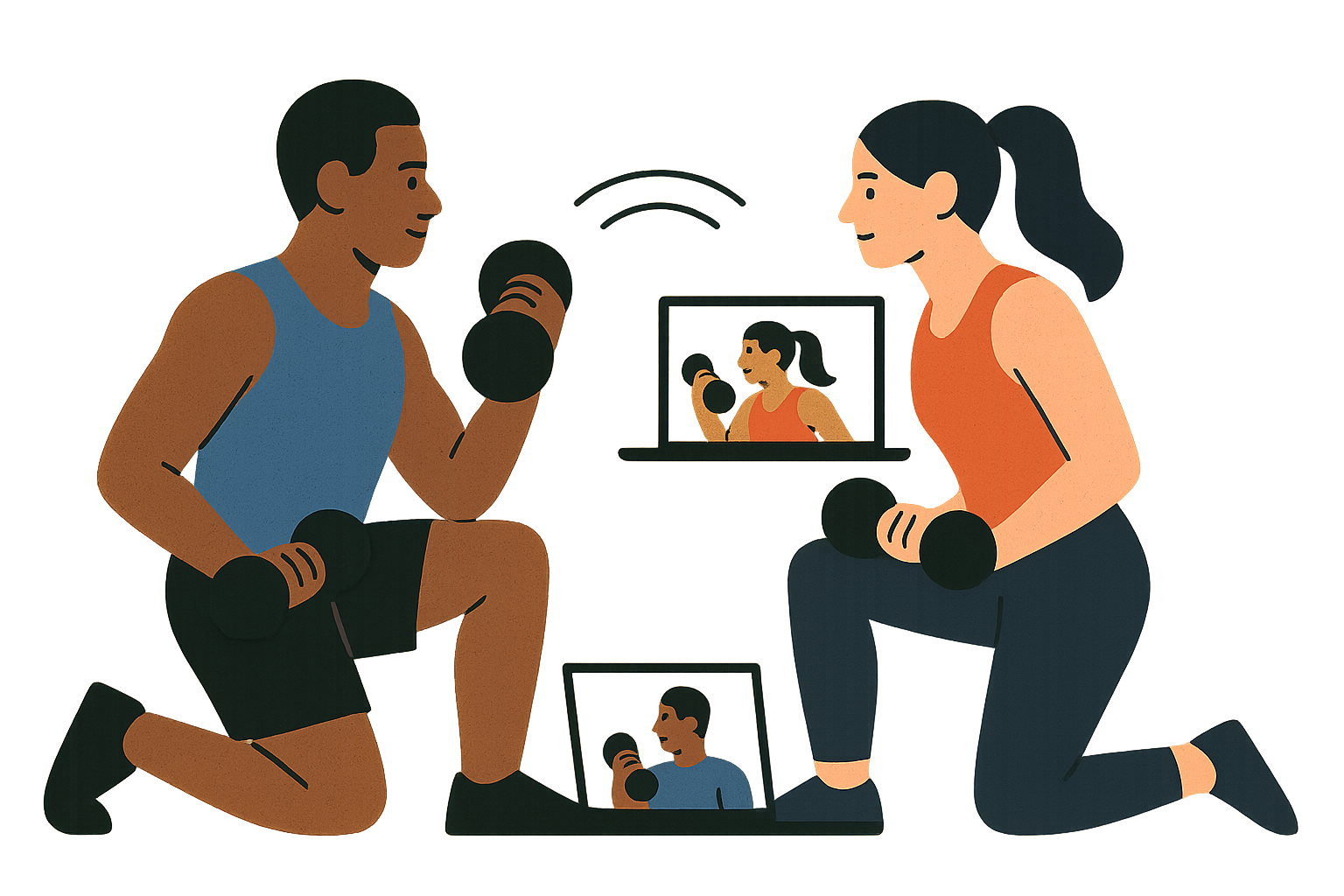
Long-distance couples can follow the same workout program in real time by setting times for video sessions and checking in with photos between workouts. Sweatmates lets couples set weekly goals together and use photos to hold each other to them, while video calls give them time to train live. The key is one simple program that both partners can sustain.
Why long-distance couples lose workout momentum faster than co-located partners
The video call replaces the meeting in the gym parking lot, but it does not automatically replace everything that happened there. There is no shared drive, warm-up chat, or easy post-workout debrief. Those small rituals gave the workout a place in the relationship before either partner lifted anything. Without them, training together needs more deliberate effort just when distance has made coordination harder.
Distance also lowers the psychological cost of canceling because nobody is standing nearby, ready to go. One missed session can turn into several, and soon working out is another thing each partner does alone. Accountability tools like Sweatmates help with this through weekly goals that partners share and photo-based check-ins that let each see the other keeping their promise. The aim is to restore some of the social friction that physical presence used to provide.
Why following the same program matters more than just exercising at the same time
“Exercising at the same time” and “following the same program” solve different problems. The first puts both partners on a call, but the second gives them a common experience to discuss after it ends. When both follow the same exercises and progressions, they have the same hard session to look back on. Otherwise, the call can amount to parallel monologues, with heavier breathing.
Both partners can follow the same push/pull/legs split with different loads, so they keep the same plan without comparing every set. The partner with more experience can give form cues, explain a progression, or help the other through a sticking point they know well.
How synchronous sessions create the feeling of training side by side
A live session works best when both partners know what happens before they open the video call. The concrete setup is the same program on the same day, with video open as both move through the sets and rest intervals together. Moving and resting at the same time lets them react, cheer each other on, and talk during the pauses. Apps built around synchronized tracking can reinforce this structure through real-time progress visibility, but the common routine is what gives the information meaning.
Across time zones, the first obstacle is finding a window. Choose two or three fixed weekly slots when both schedules are lightest and treat them as standing appointments. Video also restores part of the feedback loop that solo training lacks. A partner watching on screen may notice a collapsed knee or a rushed rep and offer a cue during the session.
A 2024 randomized controlled trial on remote-synchronous Pilates found higher adherence in the remote group than in the in-studio group, with remote adherence at 80%. Both groups also improved in physical motor tests. That does not establish that video training is always better, or that every couples workout will produce the same result. It does challenge the assumption that training remotely must mean showing up less reliably.
What asynchronous photo check-ins do that live sessions cannot
Even a well-chosen live window cannot cover the rest of the week. Both partners have to be free for a video session, while a photo check-in needs only a phone and a moment. Sweatmates uses the SweatCam mechanic to connect that moment to a weekly workout goal. After a workout, a partner takes a quick photo that the other can see immediately. The photo is the check-in itself.
A partner might see it during a quiet moment at work and register that the other person showed up today. It does not need to wait for the evening call or compete with a summary of meetings and missed trains. A week of photos also makes consistency visible in a way that a total alone does not. The record is of participation.
A 2025 study published in the British Journal of Health Psychology found that reinforcing implementation intentions with imagery increased physical activity habit strength three weeks into an intervention. That effect was maintained through post-intervention and increased at follow-up. The finding suggests a possible role for imagery in building habits. Here, the immediate value is simpler, because the partner can see the commitment being kept.
Why the wager mechanic turns a good intention into a kept promise
A weekly goal becomes more concrete when missing it has a small, agreed consequence. In the Sweatmates model, hitting the goal means no wager is owed, while missing it means owing something simple, such as dinner or a chore. Skipping is no longer only a private disappointment.
The wager needs to be mutual so neither person becomes the permanent enforcer. Both have something at stake, and both know the terms before the week starts. That makes it a shared game. Dinner should remain dinner.
Shame-based accountability can make beginners reluctant to start and turn a missed week into avoidance. A playful wager instead keeps the consequence small enough to acknowledge without turning it into a verdict on willpower. The relationship remains the setting for the goal.
How to choose a shared program both partners can actually sustain
The first filter is equipment symmetry, meaning whether both partners can do the planned movements with what they have. A barbell-heavy routine breaks quickly if one person has a gym and the other trains at home. A program anchored in bodyweight movements or resistance bands can fit both environments more readily. The best choice for this arrangement is the simplest routine both can complete most weeks.
Next, look for a clear structure with defined progressions. A simple push/pull/legs split, a full-body three-day template, or a bodyweight circuit can give them that shared language without making them meet to plan before every workout. Two to three shared sessions per week is a sustainable starting cadence for most couples, with sessions of 20 to 30 minutes keeping the schedule manageable. Partners at different fitness levels can scale their weights and reps and still do the same movements.
Finally, give the routine a floor as well as a ceiling. The ceiling is what both can manage in a good week, while the floor is an abbreviated version that still works in a difficult one. A 15-minute version keeps the habit available during difficult weeks when the full session is not.
Building the weekly rhythm that holds both mechanics together
Consider an illustrative week with partner A in one time zone and partner B in another. They choose two live windows, on Monday and Thursday, when both are free. On those days, a morning message shares the plan, the video session carries the workout, and the photo closes the loop. The before-and-after ritual still gives the workout a shared beginning and end if a live window falls through.
Tuesday might bring a photo from a walk, while Wednesday might bring one from a stretch. Those rest-day photos let each see that the other has moved without needing a full workout for every check-in. On Thursday, both partners do the same sets at the same time again, with the other days left for the week's other check-ins. The schedule is an example of how the two mechanics fit.
At the end of the week, the wager is owed if the agreed workout goal is missed. Because the wager resets weekly, a missed day does not automatically make the whole week a failure. The live sessions carry the shared training, and the photos carry the connection across the gaps. Together, they make fitness a daily thread in the relationship rather than an event that exists only in a calendar slot.
What to do when schedules split, motivation dips, or fitness levels diverge
Disruption is inevitable, and distance gives it plenty of opportunities. Travel can take away time together, work can swallow an evening, and both partners may not feel like working out at the same time. The system is recoverable because it has more than one way to keep the commitment alive. When they cannot do the full session, the floor version gives them a smaller workout, and they can use the photo channel to check in even when they are free at different times. A missed call need not become a missed connection.
Flexibility still needs some structure. A 2025 study on remote trainees found that a trainee-driven approach, where people chose sessions based on perceived readiness, led to much the same concurrent training outcomes as fixed programming. However, adherence was notably lower in the flexible group. The finding supports preserving the shared program and weekly goal while allowing some movement in when sessions happen.
If fitness levels drift further apart, the experienced partner can offer form feedback and suggest progressions without abandoning the common routine. If a goal is missed, the response can be a brief, honest conversation and the agreed dinner bet. The wager's lightness matters most at exactly this point, when guilt could otherwise lead to avoidance. Couples who see themselves as “people who work out together” are building an identity that can outlast a 30-day program. A difficult week becomes something that happened within the continuing habit.
Getting started: the first week in concrete steps
First, agree on a weekly workout goal that both can hit in a bad week, with two sessions a defensible floor for most people starting out. Use the program filters above to pick a simple routine that works in both spaces and at both fitness levels. Second, pick two or three fixed live-session windows and put them in both calendars as standing appointments.
Third, set up the SweatCam photo check-in channel and agree on a small, mutual wager, such as buying dinner or doing a chore. Keep the arrangement specific enough that neither partner has to interpret the promise later. Once those decisions are made, day one needs only the first session and the photo afterward. One program, two locations, and one connected habit is enough to begin. The first photo is the first small moment of making the distance feel smaller.