Apps That Use Shared Weekly Goals to Build Workout Consistency Between Partners
Shared accountability with a partner outperforms solo willpower during the critical early weeks.
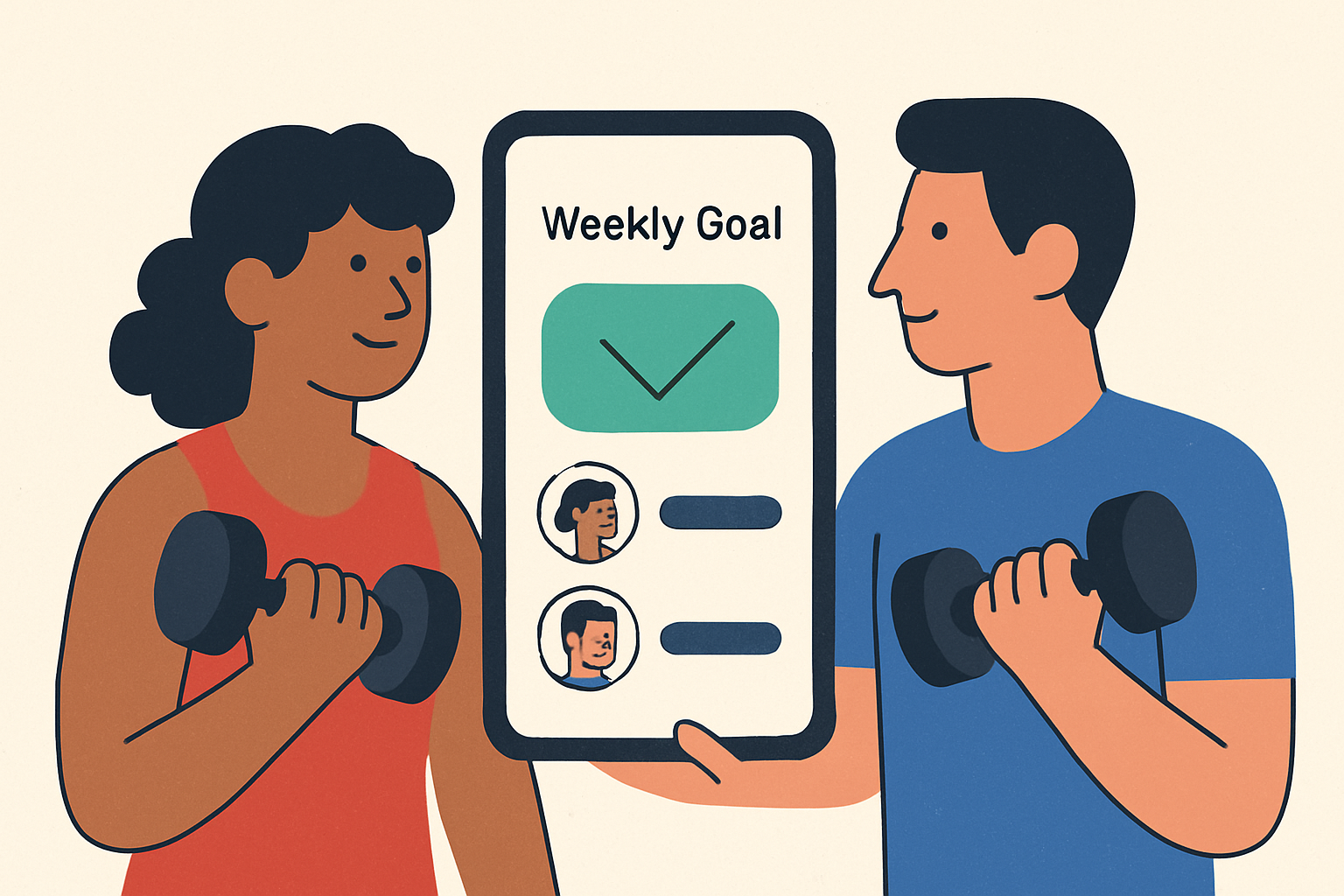
Apps that use shared weekly goals to build workout consistency between partners work by making effort a promise to another person. Their strongest feature is a simple, visible commitment that survives a busy week. A well-designed goal helps that commitment become a routine, while a poorly designed goal can lead to another abandoned app.
Why most fitness apps lose partners in the first few weeks
Signing up is the easy part because novelty does some of the work. The difficult stretch comes when that novelty fades before showing up has become a habit. The 2026 study published in Frontiers in Sports and Active Living found that training consistency during the opening weeks was the strongest predictor of long-term adherence. That makes the early weeks more than a trial period for the software. They are the period when the routine needs support.
Most fitness apps answer this problem with more information, including charts, metrics and workout history. But a fuller record does not necessarily give someone a reason to exercise on a rainy Tuesday in week three. The chart can show the missed workout beautifully, which is a slightly unhelpful talent. For two people trying to stay consistent together, the structural question is what makes showing up matter before the habit can carry itself.
Why social obligation outperforms private willpower in that window
People are more likely to complete a workout when someone will notice whether they did it. Abandoning a private plan means revising an intention, but abandoning a shared commitment means walking back a promise to a particular person. The useful ingredient is a specific, measurable commitment to someone who stays involved, even when the two people exercise at different times or places.
Researcher Dominic Cauteruccio found that a self-monitoring-only group increased exercise time more than a group that added social support. A social feature has to make people feel accountable to each other, beyond putting two names on the same screen.
Self-monitoring still asks someone to sustain the discipline of noticing and acting on their own record. During the early danger zone, a partner can give that record a social consequence by noticing the effort and responding to its absence. Tracking and accountability need not compete for the job. A shared structure gives partners a reason to keep using the tracking when their original enthusiasm starts taking unscheduled leave.
What makes a shared weekly goal structurally different from a shared workout plan
A shared workout plan tells two people what exercise to do. A shared weekly goal gives them a recurring social contract about showing up. A synced schedule asks them to be available together, while a joint leaderboard compares their results. None of those features, by itself, creates the same short, renewable commitment. The weekly boundary matters because it gives both partners a clear window for effort and a fresh start after a difficult stretch.
Useful measures include minutes moved, sessions completed and days checked in, rather than pace, weight lifted or calories burned. A beginner’s 20-minute walk and an advanced partner’s strength session can each count as a completed session. Each keeps their own programming, while they share accountability. Neither partner has to borrow the other’s body or pretend to like the same workout.
That separation also keeps the goal simple. The partners need to understand what counts, see whether it happened and know when the week resets. Complicated scoring adds friction precisely when motivation is weakest. Simplicity is what keeps a shared commitment usable during an ordinary, inconvenient week.
How photo check-ins make the weekly goal visible and social rather than private and logged
A chart records activity, but a sweaty selfie communicates “I showed up” in human terms. SweatCam photo check-ins, the main feature of Partner Fitness Review, are built around that difference. The photo is both a shared moment and a logging step. Its value comes from the person receiving it.
A photo from a walk and a photo from a heavy lifting session can carry equal social weight because both show participation. The partner sees the check-in, responds and provides a nudge through that response. The workout has happened in front of someone who cared that it happened. For couples or friends who exercise separately, this creates a small connection ritual without requiring matching calendars.
A photo-only log will not satisfy everyone who wants detailed progress tracking. That is a real trade-off, but it fits the immediate problem of habit formation. During the danger zone, showing up is the primary goal, while measuring performance comes second. Partners who want richer data can use a separate tracker without making the social check-in more complicated. The shared layer does not need a cockpit’s worth of instruments to say that someone took a walk.
How friendly stakes and small rewards reinforce the weekly goal without turning partners into rivals
Once effort is visible, a small weekly stake can give the commitment a little more pull. Loss aversion means losing something can hurt more than gaining an equivalent reward feels good, so a stake does not need to be large to matter. Having to make Sunday breakfast can be enough without turning the deal into debt collection with trainers. Small stakes make a promise playful at little cost. Stakes complement the social ritual.
The safest boundary is tiny and weekly. Making breakfast, swapping a chore or granting a small wish keeps the consequence within the relationship’s everyday life. A weekly reset prevents one poor stretch from becoming a running deficit that follows the trailing partner around. Competition also needs both partners’ consent and a fair metric, such as sessions completed or minutes moved. Otherwise, the system risks rewarding an existing fitness advantage.
The STEP UP randomized clinical trial found that competition was the only social design arm whose activity remained significantly above the control arm during follow-up. That supports taking the design of the social structure seriously, but it does not make rivalry the right choice for every couple. A joint target lets both partners work toward the same result for the week instead. Where competition feels corrosive, mutual commitment can do the work without appointing a household champion.
What the apps that actually structure shared weekly goals look like in practice
A shared habit tracker lets both partners check the same daily or weekly box, so it takes little work to see who has shown up. It may be less glamorous than a dedicated fitness app, but visibility is the relevant feature here. The selection test is whether partners can see and respond to each other’s sessions.
Partner Fitness Review makes the shared moment central through SweatCam photo check-ins. Within a weekly goal, the photo gives the other partner something concrete to notice and respond to without requiring comparable workout data. That makes its approach suited to partners whose main problem is showing up. Its philosophy also makes room for rewards and friendly wagers as playful reinforcement.
Find Your Edge’s Edge app takes a different route in its 2026 UK offering. Each partner gets a personalised plan at their own level, while partners can follow each other, give kudos on completed activities and join clubs and challenges together. Messaging with a real coach gives partners another way to stay accountable. This mix suits partners at very different fitness levels because they can cheer each other on while each follows their own programming. The individual plan and the shared social layer have distinct jobs.
Apple Fitness app competitions are built in and run for seven days, with scores based on activity ring percentage and no need for an extra app. They are limited to one-on-one competition and require both partners to have an Apple Watch. That makes the weekly boundary and visible score part of the structure, rather than something partners must remember to arrange separately. The choice depends on what the partners need most: a way to connect through photos, their own programming with feedback from others or a contest with a set end. No single mechanism has to do all three jobs.
The one design flaw that quietly kills shared weekly goals even in good apps
Every shared-goal app depends on something it cannot fully supply, which is an engaged partner. If the other person stops responding or quietly stops logging, the social obligation weakens. The record may still exist, but the feeling that someone is paying attention has gone. Dependence on an engaged partner is a structural vulnerability of the category.
That vulnerability is why partner roles need to be explicit. An accountability partner, a benchmark partner and a morale booster each help in a different way. If one person expects a nudge while the other thinks silence is respectful, the app cannot settle that mismatch. Agreeing on the kind of response wanted makes the shared layer more specific. It also keeps every missed workout from becoming an improvised relationship negotiation.
Weekly resets provide a natural point to reconnect after a quiet stretch. A missed goal should prompt reflection and a low-pressure check-in. Photo check-ins help because they are easy to send during low-motivation periods and more human than an empty data field. Still, their usefulness depends on someone answering. The repair happens when the partners re-engage with each other.
How to set up a shared weekly goal that both partners will still be using in month three
Start with an effort measure both partners can meet during a bad week. Sessions completed, minutes moved or days checked in all keep the focus on showing up. Choose a measure that works for both people without comparing pace, strength or calorie burn. The goal needs enough clarity that neither partner has to argue a case for whether an activity counts. A weekly commitment should not require its own appeals court.
Make the check-in visible on the day of the workout. A photo keeps the social signal close to the effort it reinforces. Where it fits, attach the activity to an existing couple ritual, such as a Saturday morning hike followed by breakfast or an evening walk with a question deck. The ritual gives the workout a place in the relationship rather than leaving it as another task competing for spare time. It does not require every session to happen together.
Before anyone misses a week, agree on what happens when they do. Discuss how to raise the subject without criticism and what separates a supportive nudge from nagging. Add a tiny, relational stake only if competition motivates both partners, keeping it weekly so pressure does not accumulate. If competition does not suit the relationship, use a joint target and a small shared reward instead. The agreement should make returning easier and absence easier to admit.
Give the arrangement more than one week before judging it, evaluating it at four weeks. The early danger zone extends through week eight, so that conversation gives both partners time to adjust before a shaky routine becomes an abandoned one. Review whether the goal is manageable, the check-ins are getting responses and the stakes still feel friendly. The best shared weekly goal is the one both partners can return to after a hard week, because consistency grows through connection.