Year-Long Fitness Challenges for Couples or Friends
Pairing up with accountability check-ins boosts your odds of sticking to fitness for a full year.
Roughly 48% of people list fitness as their top New Year's priority, making it one of the most commonly cited resolutions. Data on app-tracked runners has flagged January 12th as the day most people quietly give up, and by mid-February dropout rates climb to around 80%. This piece is about why that happens and what actually works: a structure built for two people or a small group, sustained across a full twelve months.
A Forbes Health poll lays out the collapse in ugly detail. Only 8% of resolvers made it a full month, and by two months, 21.9% were still going. Three months came in at 22.2%. And by the eleven or twelve month mark, just 1% remained. The pattern points less to motivation than to a design flaw wearing a motivation costume.
Here's the twist, though. The Journal of Clinical Psychology found that people who make explicit resolutions succeed far more often than people with the same goals who never formalize them, 46% versus 4% at six months. So the commitment itself isn't the weak link. A resolution without structure is a single glass ornament: gorgeous, fragile, and one bad month away from shattering into something you can't tape back together. A challenge, on the other hand, is built like a set of stairs. Miss a step, and there's another one right there waiting.
What social accountability does to effort and follow-through
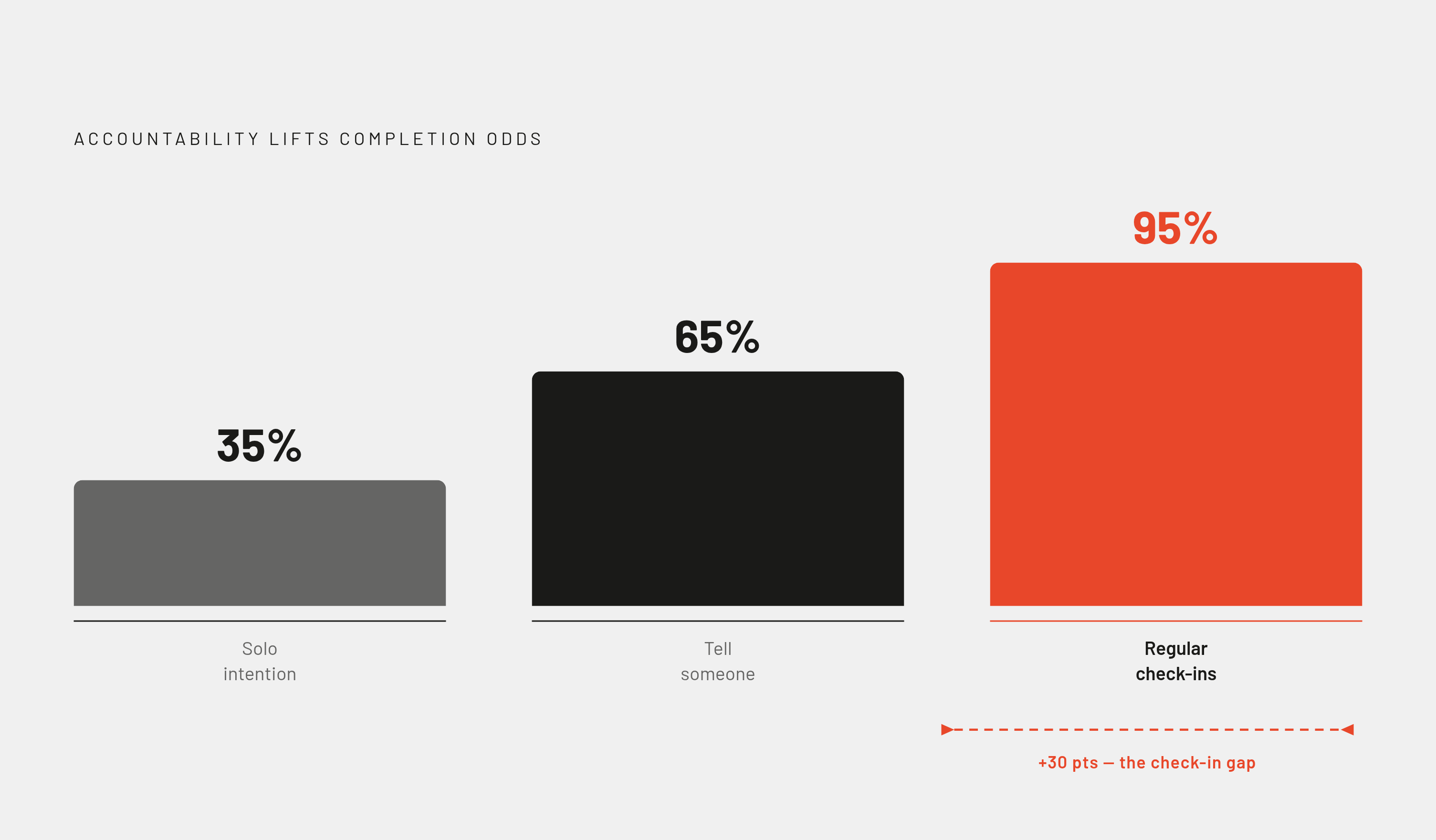
Tell someone else your goal, and your odds of finishing jump to roughly 65%, according to research from the American Society of Training and Development. Add regular check-ins, and that number climbs to 95%. The gap between "eh, maybe" and "basically inevitable" comes down to that one habit of checking in.
Michigan State University research found something even more dramatic: people exercising with a partner increased their workout duration and intensity by up to 200%. That figure turns a routine session into a fundamentally different workout.
Some of this comes down to a quirk of human psychology called the Köhler Effect. People who see themselves as the weaker link in a team tend to push harder, not because anyone's yelling at them, but because nobody wants to be the reason the group falls short. Studies on this effect found the weakest performer in a pair or group can increase output by up to 24%, simply from not wanting to be the drag. Translation: pairing up with a slightly fitter friend or partner boosts your performance without you having to summon extra willpower from thin air. The group does the motivating for you.
The broader pattern holds at scale: buddy systems, partner contracts, and walking groups consistently produce meaningful jumps in physical activity among adults. But couples deserve a specific asterisk here. A 2024 study out of NTU, looking at 240 married adults between 54 and 72, found that spouses who exercised together were sometimes less active than when exercising solo. Accommodating a partner's slower pace, it turns out, can quietly shave off your own output.
The lesson is that teaming up needs the right format: room for both people to move at their own speed while still feeling like they're in it together. Willpower is a limited resource, and everyone runs out of it eventually. Social accountability, leaderboards, and check-ins act as the backup generator that kicks in when internal motivation flickers out.
How a shared challenge changes a relationship, not just a workout log
A BYU study tracking nearly 1,700 young married couples found that shared physical activity, walking especially, was linked to better communication, calmer conflict resolution, and lower marital stress. And the effect was stronger for joint exercise than solo exercise. Sweating next to your spouse apparently teaches you something that sweating alone does not.
The clinical world backs this up too. The relational benefits of shared exercise extend beyond motivation. That pattern reaches past motivational fluff into the relationship itself, not merely the step count.
Here's where it gets practical. The reward at the end of a challenge should reinforce togetherness, not just performance: a movie night, choosing the weekend activity, cooking dinner as a team. And the timing of the workout matters more than people admit. An evening walk that both partners will actually do beats a 6 a.m. bootcamp that only one of them is excited about. Enthusiasm is not something you can borrow from your partner at 5:45 in the morning.
There's a design trap worth naming directly. If one partner treats the challenge like a scoreboard and the other wants a shared ritual, friction shows up fast, usually within a couple weeks. The strongest setup is a two-person accountability system built around one habit both people will repeat, free of leaderboards and stopwatches. Friendly wagers, a photo sent after a walk, a small reward for hitting a milestone, these turn good intentions into action without turning the whole thing into a contest that quietly undermines the relationship it was supposed to strengthen.
The design principles that keep a year-long challenge from collapsing in month three
A year-long challenge isn't one long unbroken streak, and treating it that way means it snaps the first time life gets in the way. It's a sequence of connected checkpoints, each one giving partners a reason to come back even after a bad week.
The first few weeks matter more than people think. Research on early training structure suggests that calibrating difficulty appropriately from the start drives enjoyment and helps people stay consistent. Starting too hard wrecks a challenge just as fast as starting too soft does, since month one isn't for setting records but for building the habit of showing up.
Small groups beat big ones, consistently. On one social fitness platform, roughly 7 in 10 challenges end without a single person joining, which shows that scale doesn't save a bad structure. The median group size on that same platform is around 8 people, small enough that everyone recognizes everyone else's name, which is exactly the condition public accountability needs to function. For couples or close friends, three or four committed people will always outperform a group chat of thirty strangers cheering from the sidelines.
A missed goal should trigger a shrug and a reset, not a spiral of guilt. Build monthly resets into the calendar so there's a natural re-entry point instead of an all-or-nothing streak that punishes one bad Tuesday for the rest of the year. Mix up the challenge types across the twelve months too: some months chase output (mileage, steps), some chase consistency (percentage of workouts completed), some chase habits (sleep, nutrition, recovery). Anchor a few months to the seasons or a local event, weather changes and holidays make natural checkpoints on their own. And measure progress by consistency first, since showing up deserves applause even on days when performance doesn't.
Mileage and accumulation challenges that scale across all twelve months
The "Run the Year" format is exactly what it sounds like: rack up mileage equal to the year itself, 2,026 miles in 2026, for example, split between partners or raced individually on a shared tracker. There's no official start date and no strict calendar entry point, so a couple can jump in during March without feeling like they missed the boat.
For beginners, a simpler version works just as well: roughly a mile a day for the year, with rest days baked in and totals reviewed weekly instead of daily. The math is forgiving on purpose.
The reason accumulation challenges hold up over twelve months comes down to arithmetic and psychology combined. Every session adds to a visible running total, so one missed day doesn't erase the whole year's effort, it's a dent, not a demolition. And a big round number, like a mileage total tied to the year, gives the challenge a built-in story arc: a third of the way there, halfway, then the final stretch.
This format isn't locked to running, either. Monthly mileage clubs work fine for walking, cycling, rowing, or any cardio a couple actually enjoys enough to repeat. Cyclists can build an entire year around it: start with short local rides, stretch the distance and elevation month over month, and land on a century ride, 100 miles, as the year's grand finale. That century isn't just a workout. It's a shared event, a finish line the whole year has been quietly building toward.
None of this requires fancy software. A shared spreadsheet, a running app with partner access, or a whiteboard on the fridge that both people glance at every morning does the job just fine.
Progressive challenge structures that build toward a single year-end goal
The 5K-to-marathon arc is the classic version of this idea. Start with a manageable distance, add mileage month by month, and finish the year at a half-marathon or full marathon. Each month becomes its own chapter, and couples cross each distance milestone together before moving on to the next. Log it in a shared app or journal, and you're not just tracking fitness, you're tracking the plot of your year.
There's a psychological reason this works so well. The 2026 Frontiers in Sports and Active Living study found that progressively harder sessions build self-efficacy, meaning each finished block makes the next one feel more doable. It's momentum, but the kind that compounds.
Some couples like to drop a genuinely hard block into an otherwise gentle year, something like the 75 Hard framework (two 45-minute workouts daily, one outdoors, no alcohol, a gallon of water), but treated as one quarter's challenge instead of a standalone grind. Framed as a single chapter with a known end date and a recovery period waiting on the other side, the intensity becomes sustainable instead of punishing.
There's also a strength-based version of this arc: pick a small handful of foundational lifts and track them across the year, aiming for a specific number by December rather than logging every single set. It's simple enough that two people at wildly different experience levels can both play the game on their own terms.
The rule that ties all of this together: the year-end goal needs to be big enough to actually require the full twelve months, but believable enough in week one that nobody's rolling their eyes.
Monthly reset formats that give partners a fresh start every thirty days
Monthly consistency challenges swap the all-or-nothing streak for a target, say, most of their scheduled workouts completed. Miss a day, and the challenge isn't broken, it's just a slightly lower percentage. Partners compare numbers at month's end, then flip to a fresh card and start again.
Wellness Bingo takes this further: a 5x5 grid of health tasks, drink enough water, do a yoga session, run a set distance, cook something new, sleep eight hours, all completed within thirty days. Swap in a new card each month, themed to the season, and finishing a row or the whole board becomes a small monthly milestone worth celebrating.
Monthly habit streaks strip things down even further, one simple daily commitment (a morning walk, ten minutes of stretching, no screens after 10 p.m.) that both partners adopt for thirty days. The simplicity is the entire point, since a single habit is far easier to sustain as a shared ritual than a sprawling program nobody can remember the rules to.
There's real evidence behind the monthly-reset approach. Research on structured, socially-supported challenges consistently shows completion rates that outpace most solo fitness programs. Monthly formats replicate that same social scaffolding over and over across the year instead of burning through all the motivation in one long, unbroken push. Rotate the theme by season, winter flexibility, spring mileage, summer swimming or hiking, fall strength, and each reset feels genuinely new instead of the same assignment on a different sheet of paper.
Team and group formats for friends who are not training together in the same room
Nobody needs to be in the same gym, or even the same city, for this to work. The challenge itself supplies the glue, more than any shared session could. A photo of a finished workout dropped into a group thread carries more weight than any private dashboard number ever will, because someone else actually sees it.
Relay and team accumulation formats split a collective mileage goal across a group, with each person's contribution visible to everyone else. Virtual triathlons, relay marathons, and team step challenges all run on this same engine. Tie the total to a charity fundraiser, and the miles suddenly mean something beyond the group chat.
Group event anchors work well too: one shared race or event per quarter, a local 5K, a mud run, a charity walk, that the group trains toward on their own schedules but shows up to finish together. The event is the milestone, while the training leading up to it is the actual challenge.
Fitness Bingo scales to a group the same way it works for couples, each person runs their own card, but the group compares notes weekly and cheers whoever finishes a row first. Add a friendly wager for extra bite: whoever has the lowest consistency that month buys dinner, or picks the group's next activity. It adds stakes while keeping training partners from turning into rivals.
And the group-size math from earlier still applies here. Three or four committed friends will beat a sprawling, passive group chat every time, and everyone should know everyone's name and notice when someone goes quiet.
The apps and tools that track a year-long shared challenge without overcomplicating it
Pick the challenge format first, then find the tool second. A shared spreadsheet or a kitchen whiteboard will beat a slick app every time, as long as both people actually check it daily. Simplicity here is a feature, not a compromise.
For running and cycling accumulation challenges, look for a free platform that records GPS activity, shows a shared feed, and lets partners cheer each other's sessions. For step-based or mixed-activity challenges, especially in groups where some people walk and others cycle, Stridekick supports mixed-device competitions with preset challenge calendars built in. For strength-progression tracking, Hevy lets partners follow each other's lifts and compare logs side by side, well suited to the lift-tracking arc described earlier. And for couples already living inside one device ecosystem, both Apple Fitness and Samsung Health support built-in friend competitions with almost no setup required.
Whatever the tool, the job is the same: make the shared progress visible enough that neither person forgets they're not doing this alone. The tracker serves as the mirror that shows both people the year they're building, one walk, one mile, one bingo card at a time.