Apps That Sync Fitness Goals Between Partners Across Different Gyms and Schedules
Photo check-ins and cross-wearable scoring let couples stay accountable apart.
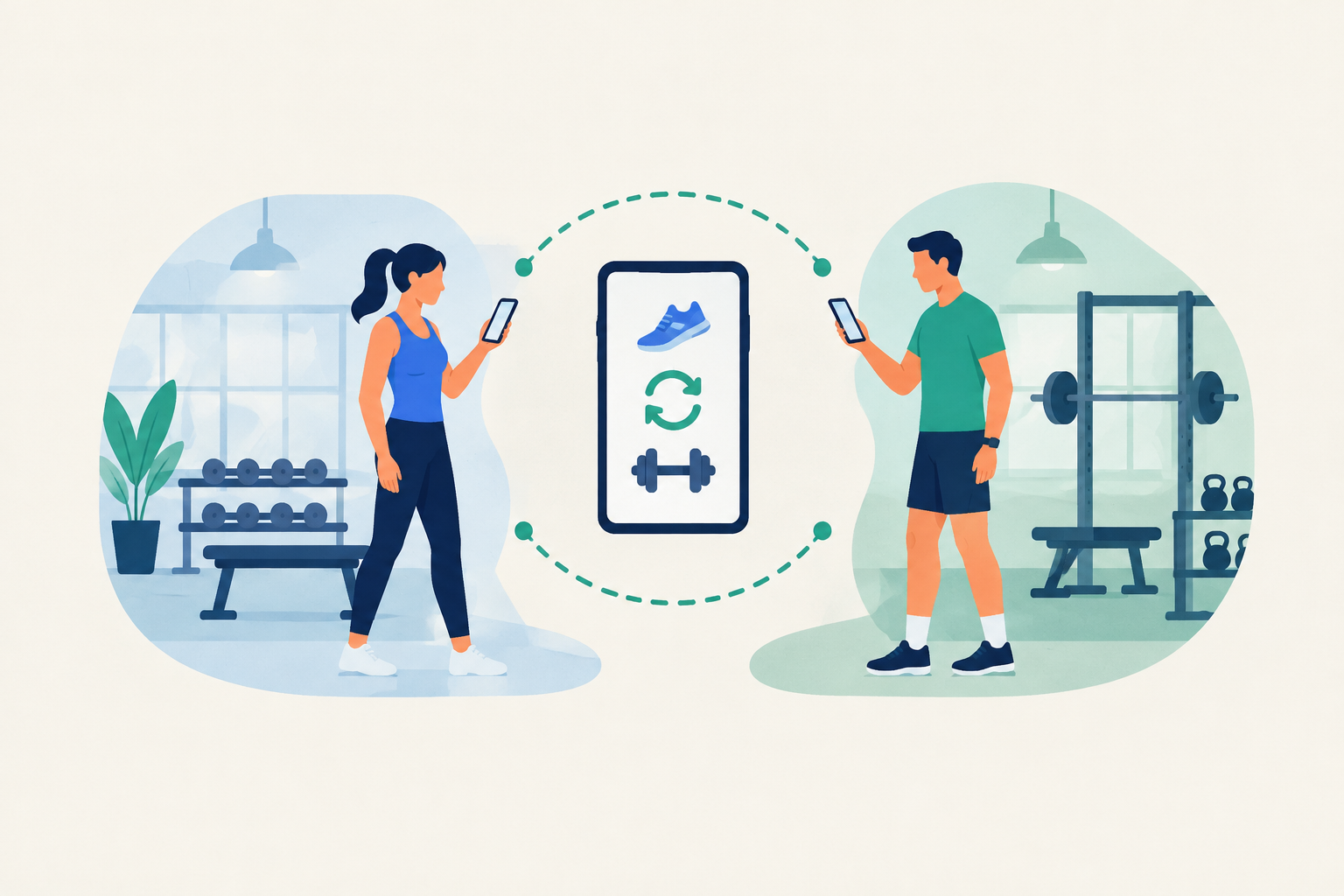
The best couples workout app depends on what keeps you apart. SweatCam suits partners who want photo-based accountability across different gyms and schedules, while MoveTogether suits those who want cross-wearable competition measured against personal goals. Syncing fitness goals works best when it makes effort visible and support easy, without requiring matching devices or matching calendars.
Why syncing fitness goals between partners at different gyms is harder than it looks
Partners can share a fitness goal without sharing much else about how they train. One uses an Apple Watch, the other a Fitbit, Garmin, WHOOP, or no wearable at all. Their gyms differ, and their free time rarely overlaps. That is a compatibility problem. More willpower will not persuade two incompatible systems to exchange data.
A feature that lets partners train together remotely still needs both people to be free together. For busy professionals, that can turn a workout into one more meeting to find time for, only with worse lighting. Different devices, gyms, and time windows are the normal case this category needs to accommodate. Solving it requires a broader definition of syncing than “share your stats.”
What "syncing" actually needs to do when partners train apart
Useful sync makes individual effort visible soon after it happens and connects it to a goal both partners care about. It can work without showing the same numbers on the same screens. The shared goal is the point of connection. Each person should be able to contribute without waiting for the other to finish a meeting, reach the gym, or open an app.
Counting raw steps or calories tends to give the fitter partner the edge, so both can guess who will win before they start. MoveTogether’s Percentage of Goals measures how each person does against their own target instead. With SweatCam, someone posts a workout photo when they train, and their partner sees it whenever they next open the app. Neither approach requires simultaneous attendance.
One makes unlike performances more comparable, while the other makes effort visible without performance numbers. That distinction gives partners a better basis for choosing than the length of a feature list.
Why social accountability changes whether the workout happens at all, not just how it is recorded
Sets, reps, and GPS routes are useful records, but they describe activity after someone has decided to do it. A partner who expects to see a check-in adds a reason to follow through before the workout starts. The audience changes the decision.
Western University’s 2025 study by Lisa Nguyen, Guy Faulkner, Carolyn Taylor, and Marc Mitchell, published in the British Journal of Sports Medicine, provides evidence that digital tools can produce behavioral change beyond short-term spikes. That supports taking social design seriously rather than treating it as decoration around the tracker. Yet social features can work in different ways, by helping people support or compare themselves with each other. Being encouraged is not the same as being ranked. Public leaderboards can alienate beginners or people who simply dislike competition.
For partners struggling with consistency, who sees the effort and how they respond can be more useful than finer tracking precision. That connection has extra weight when the audience is someone with whom a relationship already exists. A check-in is then more than an update sent to a screen. It is follow-through made visible to someone who knows you.
How photo check-ins work as a habit-formation mechanic for partners at different gyms
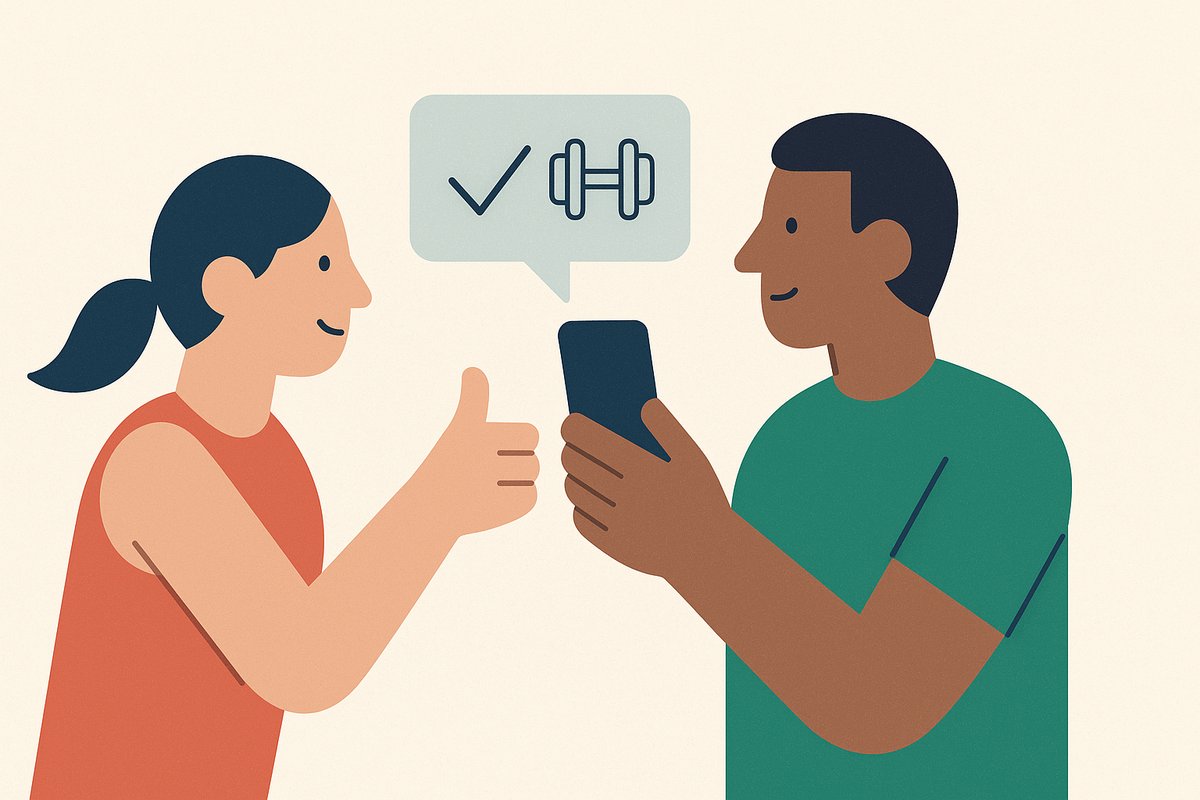
Partners set a weekly goal for how many days to work out, then snap a quick photo when they train. The photo is visible immediately, but the partner can view it later. Different gyms and time zones do not interrupt that exchange.
The photo signals presence. A beginner and a seasoned exerciser can therefore work toward a shared attendance goal without comparing calories or distance. Posting also gives follow-through an audience, making sharing part of the commitment. A light wager, such as buying dinner after missing the week’s goal, can add stakes without a leaderboard.
There are clear limits to this simplicity. SweatCam is iPhone only, supports two people, and requires a subscription for logging. Its check-ins are self-reported and unverifiable, so a photo is not an audit of what happened at the gym. Taking one also adds friction on days when someone would rather tap “done.” The trade is less performance data in exchange for a visible, personal record of showing up.
Apps built for cross-wearable competition and what they actually require to work
MoveTogether takes on the harder data problem. Cross-wearable competition requires server-side normalization because device readings cannot simply be treated as interchangeable. Its Percentage of Goals measures how far each person has come toward their own targets. That gives mixed-level partners a way to compete on terms that account for their different starting points.
This approach does not strictly require a watch. Apple Health and the iPhone’s motion data can supply activity without one, which helps when only one partner owns a wearable. The trade-off is precision. Normalized figures are approximations rather than raw transfers, and partners who closely follow their device’s native readings may notice differences.
MoveTogether also offers a more elaborate motivational layer. Coach Mo’s major upgrade added five personalities, including Roast mode, long-term memory, real-time competition strategy, a daily Morning Brief, and a shareable Weekly Recap. Move Leagues match users into a weekly league with people at their level. Pro is available at monthly or annual rates on Apple, with a lower web rate available. For partners who enjoy competition, those features give them more to do together than check whether the other person worked out.
Same-brand ecosystems: when built-in social features are enough and when they break down
Apple Fitness+ with SharePlay lets partners take the same yoga or HIIT class while they are in different places. Each sees their own metrics, while notifications show when the other closes an Activity ring. Both need an iPhone or iPad and an Apple Fitness+ subscription. An Apple Watch is recommended and optional. This solves distance, but a shared class still needs a shared window of time.
With Garmin Connect, partners can go head-to-head in step challenges and compete for badges through Challenges and Connections. The competition functionality is essentially free for partners who already own the devices. Its boundary is the data it can see. Garmin Connect cannot see Apple Watch or Fitbit data, so it cannot bridge a pair split across those ecosystems.
WHOOP Teams lets groups of any size compare Strain, Recovery, and Sleep leaderboards. It fits partners already using WHOOP for recovery insights, though the device and subscription cost is substantial and social features are not its primary purpose. These options are convenient inside their own ecosystems. Outside them, access becomes a hardware or subscription decision.
Group accountability as an alternative to the two-person model
A pair can stall when one person has a difficult week. A small group provides a buffer because other members can keep checking in while someone struggles. Habit Huddle is built around that model. Each member maintains a personal streak in days, while the group builds a Checkin Chain that gains one link for every member who checks in that day. The shared goal need not disappear when one calendar catches fire.
Each habit also has a Floor, the smallest version someone will do on their worst day, and a Ceiling, the goal to burst through on big days. Reduced effort is not automatically treated as failure. Habit Huddle works on web, iOS, Android, Discord, and Twitch, allowing a group to check in without sharing a gym, city, or time zone. Its free plan covers one active habit, enough for a gym accountability group. There is no wearable sync or GPS, and check-ins rely on someone’s word with an optional photo.
The STEP UP randomized clinical trial found that gains from competition-based social gamification partially persisted, at reduced levels, after the intervention ended. That gives a reason to try group competition beyond the fun of a busy chat, though it does not show that Habit Huddle itself works. Data-focused athletes will want a tracker as well, and the accountability is only as useful as the friends who participate.
The gamification question: when competition helps and when it backfires
A challenge can make an otherwise forgettable session feel worth completing, and the STEP UP findings give advocates reason to argue that some benefits outlast the contest. That is a legitimate design choice. For partners who enjoy trying to beat a target or each other, rankings can supply energy.
The opposing case is about what remains when novelty fades. A streak is a proxy for commitment, while social accountability is the commitment to another person. A standing habit relationship can make accomplishment visible without needing a winner. Public rankings, by contrast, can discourage the beginners most in need of support. The same comparison that excites one partner can make the other avoid opening the app.
Raw-output contests reward the stronger starting position, while Percentage of Goals makes the standard personal and photo check-ins remove performance comparison altogether. Light wagers sit between witnessing and full competition. They add stakes without publicly ranking anyone, although whether buying dinner feels playful depends on the pair. A couple’s dynamic cannot be fixed by better scoreboard graphics.
Research on exercise intensity and adherence is mixed for beginners, with some studies finding reduced enjoyment and possible harm to adherence at high intensity, and others finding comparable adherence between moderate- and high-intensity groups. Harder is not automatically more sustainable. The practical choice depends on whether partners want a performance push or a routine they can sustain, and which mechanic makes both willing to return.
Which couples workout app fits your actual compatibility problem?
To choose an approach, start with the mismatch that actually prevents shared progress. If both partners already use the same ecosystem, the built-in social features may be enough. Garmin Connect works for challenges that use devices, WHOOP Teams works for partners who both care about recovery, and Apple Fitness+ SharePlay works for taking a class together from different places. Use what you already have before buying hardware to get a social feature. Matching devices, however, will not create matching free time.
If the obstacle is different wearables, MoveTogether’s normalization is the direct route to a shared competition. It can also accommodate iPhone activity without a watch. If finding the same free time is what gets in the way, SweatCam’s photo check-ins let partners hold each other accountable without training at the same time, as long as both can use its iPhone-only, two-person setup. The distinction is simple but useful. Choose data compatibility when comparing progress is the goal, and schedule independence when seeing each other show up is enough.
If fitness levels differ, the standard needs attention before the app does. Personal goal percentages or performance-free photos avoid making the fitter partner’s output the benchmark. If a pair needs support even when one of them has a low week, a small group gives them others to lean on. Choose the app that makes a simple shared goal and mutual support fit both partners’ real lives.