Best Fitness Apps for Accountability With No Subscription Fee
Social support beats leaderboards for keeping people consistent and engaged.

Here's the number that should change how you think about fitness apps: apps with active social features see 5x higher retention than solo workout models. Five times. Apps with challenges, leaderboards, or friend connections see 20 to 35% lower monthly churn. Users with an accountability partner are 40% more likely to still be working out six months in.
These aren't numbers pulled from competitive athletes or fitness obsessives. This is what happens across massive, ordinary populations.
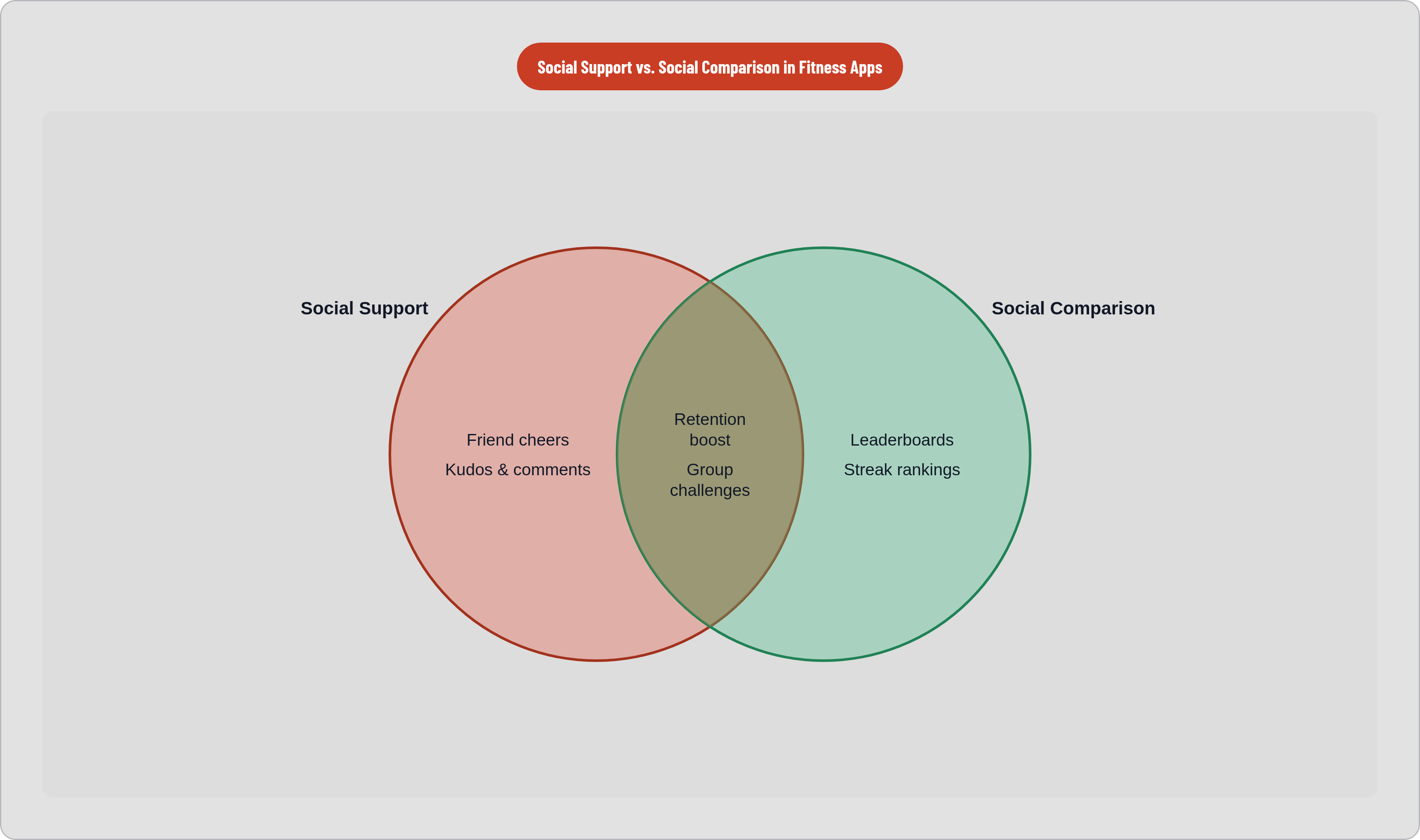
But the research draws a line that actually matters for picking an app. Social support and social comparison are not the same thing, and they produce different results.
- Social support means a friend notices you showed up. Someone cheers. Someone asks how the run went.
- Social comparison means you're ranked. You're competing. You can see exactly where you fall on the leaderboard.
Support helps most people. Comparison helps some people and sends others into a quiet tailspin where they stop opening the app entirely. If you're the kind of person who sees a leaderboard and thinks "I'm getting to the top of that," great. If you see one and think "I'm already losing," it's going to work against you.
Streaks are useful but have a known failure mode most people will recognize from personal experience. You miss a day. You feel like you've ruined it. You stop. That's not weakness. That's a predictable psychological response to an all-or-nothing reward system, and app designers know it happens and build the streaks anyway.
A meta-analysis of 36 randomized controlled trials with thousands of participants found that gamified health apps did produce real improvements. Not dramatic ones. 489 additional steps per day, 0.70 kg less body weight. Real, but modest. A 2025 study added the wrinkle that moderate gamification outperforms both minimal systems and overloaded ones. More mechanics isn't automatically better. Sometimes it's just more noise.
The takeaway is simple: look for social connection and low-key accountability. Leaderboards and streaks are secondary.
What "Free" Actually Means Across These Apps — and Where to Watch for the Catch
"Free" is the hardest-working word in the fitness app business, and it almost never means the same thing twice.
There are really three versions hiding under that label:
- Actually free. Nike Training Club has no paid tier. Nothing is locked. Everything works.
- Free enough. FitOn and Nike Run Club let you use the core experience indefinitely without paying. They'll nudge you toward premium, but you can ignore it forever and still get real value.
- Free in name only. Ad-saturated, feature-stripped, or both. By 2025, JEFIT has drifted pretty clearly into this territory.
There's also a fourth pattern worth naming because Strava is the textbook case. Some apps built their communities entirely on free features, then quietly moved those features behind a paywall once the user base was large enough that people felt stuck. Strava is still worth using. But you should know that's the trajectory.
The filter that actually matters for this piece is narrower than just "what does the free tier include." It's: can two people use this together without one of them hitting a gate the other person doesn't hit? Because if one partner gets locked out of a feature and the other doesn't, the social layer breaks. The whole point is that both people are in the same experience.
One more number worth knowing: annual subscriptions to fitness apps retain only 33% of users. Paying doesn't reliably make people consistent. So the argument for a paid tier, from a pure habit-formation standpoint, is weaker than the apps want you to believe.
Nike Run Club and Nike Training Club — Genuinely Free and Built for Showing Up
The reason Nike's apps are the cleanest free options on this list isn't because Nike is generous. It's because Nike sells shoes. The apps are marketing infrastructure. When your real product is physical goods, you don't need to monetize the software — you need people to keep running so they keep buying things.
That business model alignment is why the free experience doesn't feel squeezed.
Nike Training Club has been fully free since March 2020. No paid tier. No locked workouts. Every filter, every class, every feature — all of it, for nothing. That's unusual enough in 2025 that it's worth saying twice.
Nike Run Club is the same deal. Guided runs, training plans, community challenges, friend cheers, Apple Watch integration. All free. Over 100 million users across 160 countries, with a gamification layer that goes from Bronze through Hall of Fame and includes weekly challenges and badges along the way.
The specific accountability feature in NRC is friend cheers during runs. It's a small thing. Someone can send you a cheer while you're mid-run and it plays through your headphones. But small signals that someone else knew you went out — that's actually what the retention research is pointing at. Not elaborate systems. Just visibility.
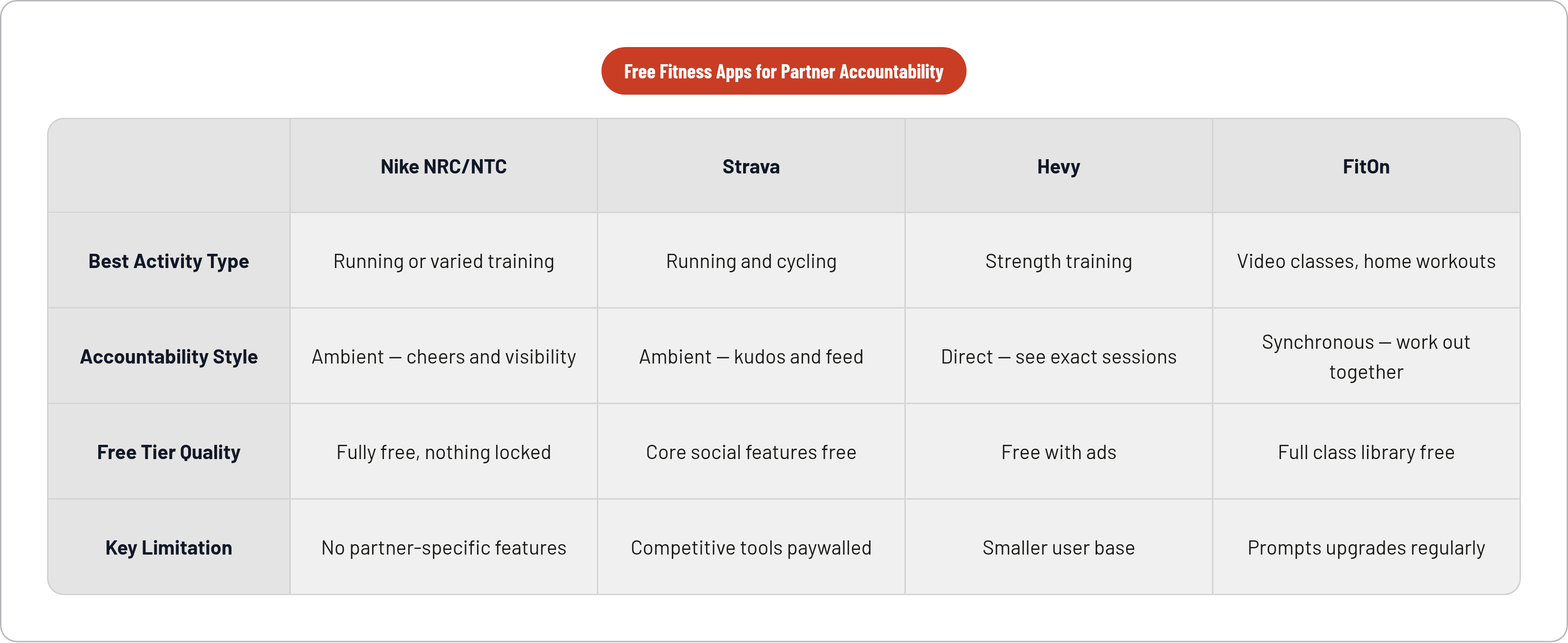
NTC makes more sense for partners doing varied training together (strength work, mobility, yoga). NRC is built for runners. Neither app has a deep social feed or partner-specific features. The accountability is ambient. You know someone else is active. You can see their activity. You can't necessarily drill into exactly what they did, which is either fine or a limitation depending on what you're looking for.
Best for: partners who want to share an activity with some social layer and absolutely zero subscription friction.
Strava — The Most Social Free Running App, With Caveats About What "Free" Still Means
Strava is the closest thing fitness apps have to an actual social network, and the numbers back that up. As of December 2025: over 180 million users in more than 185 countries, 51 million activity uploads per week, 3 million new signups per month. In 2025 alone, 14 billion kudos were given. Strava Clubs nearly quadrupled, with over 1 million clubs total and running clubs specifically growing 3.5 times.
The free tier still includes the parts that make Strava socially useful:
- GPS tracking
- Activity feed
- Kudos and comments on activities
- Club membership
- Segment efforts (seeing your time on a known route)
What's behind the paywall ($11.99/month or $79.99/year): segment leaderboards, advanced training load analysis, custom goals, smart routes. Basically the competitive and coaching infrastructure.
Here's the real Strava story, told plainly. The company raised over $110 million partly on the back of its free community, then progressively moved features to paid as it scaled. In 2025, a Reddit thread titled "Is Strava pushing subscriptions too hard?" scored 619 points. That's a significant number. And in April 2025, Strava acquired Runna and bundled both at $149.99/year, which suggests the paid tier is going to keep getting more ambitious. Worth watching.
But for accountability between two people on the free tier? Still enough. Following each other, leaving kudos at 7am, dropping a comment on a tough run — that's a real loop. That's the thing the retention research actually describes when it talks about social features working.
Best for: runners and cyclists who want a social feed and community, and can live without leaderboard access.
Hevy — Strength Training Accountability With a Social Layer That Free Users Can Actually Use
Hevy is built around the culture of lifting, which makes it feel different from the other apps on this list. You follow friends, you see their actual workouts (the exercises, the sets, the weights), you share routines, you post training clips. It's not ambient visibility. It's specific.
The automatic personal record tracking is genuinely useful. When you hit a new PR, the app catches it and flags it — which creates a small moment of shared recognition without anyone having to announce anything. It just surfaces. Your partner sees it. That's a nice design choice.
The free version includes ads. That's the tradeoff, and it's honest. Data export is available, which matters more than people think until the day they want to switch apps and realize they have years of training logs to preserve.
The accountability mechanism is more direct here than in NRC or Strava. You're not just seeing that your partner worked out. You're seeing the exact session they ran. That specificity either motivates you or makes you quietly competitive with yourself. Either outcome moves you toward the gym.
The limitation is size. Hevy's user base is smaller than Strava or NRC by a significant margin, which means convincing your actual training partner to download and use it requires a real ask. It's not the app everyone already has. But if both people buy in, the experience is more purpose-built for accountability between specific people than anything else here.
Best for: partners or friends who lift separately and want to actually see each other's sessions.
FitOn — Free Group Workout Classes With a Social Layer for Exercising Together Remotely
FitOn's basic offer is a full library of trainer-led video classes — HIIT, Pilates, yoga, strength — free, no subscription required. That's already a decent deal. The social layer is what makes it relevant here.
You can invite friends to do the same class at the same time, from different locations. Not log-and-compare later. Do it together, live. That's a different accountability mechanism than anything else on this list. It's synchronous. It's the closest these apps get to actually working out with someone when you can't be in the same room.
There's also a real-time leaderboard within classes, which adds light competitive energy without requiring both partners to be at the same fitness level. You're competing within the class context, rather than directly against each other.
Premium adds offline downloads and personalized meal plans. The free class library isn't stripped down to get you to pay. It's the actual experience. The app does prompt upgrades and surfaces content packs, which is worth expecting. It's not aggressive enough to be a dealbreaker, but it's there.
Best for: partners who want to work out "together" from different locations, or a household that wants to do a class in the same room without coordinating logistics.
JEFIT — Worth Knowing About, but the Free Tier Has Become Harder to Use
JEFIT has the right structural pieces for an accountability app. Strength training focus, community leaderboard, a large exercise database, logging tools. A few years ago it was a legitimate free option.
By 2025, the free experience has enough friction to make it worth flagging honestly. The free tier caps saved routines at three, which is a real constraint for anyone doing varied training. Ad frequency has gotten to the point where multiple independent reviewers specifically mention it disrupting actual workouts — not just existing between sessions, but interrupting them. Full access sits behind around $70/year for Elite.
The accountability features technically still exist. The leaderboard is there. Social tools are there. But getting to them through the free experience is harder than it used to be, and harder than it should be.
JEFIT is included here as useful context, not as a recommendation. The fact that an app can be technically free and practically unusable is worth understanding when you're evaluating anything in this space. "Free tier exists" and "free tier functions" are two different things.
How to Choose Between These Apps Based on How You and a Partner Actually Work Out
The question that matters most isn't which app has the best features. It's which app both people will actually open again next week. Start there, because an accountability tool that only one person uses is just a personal workout log with extra steps.
After that, three things cut through the noise.
What you're doing:
- Running or cycling, together or separately → NRC or Strava free tier
- Strength training logged in separate gyms → Hevy
- Video classes or home workouts → FitOn or NTC
How accountability works for you:
- Ambient (I like knowing my partner is active, even if I don't see the details) → Strava or NRC kudos and feed
- Direct (I want to see exactly what they did) → Hevy
- Synchronous (I want us to do the same thing at the same time) → FitOn group feature
How much friction you can tolerate:
- Zero barrier, no subscription navigation for either person → NTC, full stop
- Fine with ads in exchange for social features → Hevy or FitOn free tier
- Expecting to want more as time goes on → Strava, knowing some features will eventually cost more
The simplest test: which app would both partners open without being reminded? Everything else is a secondary concern.
What These Apps Can and Can't Do — and Where the Actual Accountability Comes From
Annual subscriptions to fitness apps retain only 33% of users. Paying money for an app doesn't reliably make people consistent. That number is worth sitting with for a second, because it reframes the whole conversation. The app is infrastructure. The consistency has to come from somewhere else.
Social features meaningfully improve retention. But the social feature only functions if the other person is actually present. An accountability loop with no one on the other end is just a notification you learn to ignore.
The research distinction between social support and social comparison becomes practical here. Apps that start to feel like surveillance — tracking whether your partner ran, keeping score, ranking performance against each other — can quietly erode the partnership they were supposed to support. There's a version of accountability that starts to feel like having a parole officer who also knows your VO2 max, and that version makes people want to quit the app and possibly the relationship.
The things that actually work are smaller than any of these apps want to admit. A text after a hard session. A kudos left on a Strava activity at 7am. A shared laugh about a workout that did not go the way anyone planned. These compound over time, and none of them require a subscription tier.
The apps in this piece are free because their value is social, and social value requires other people to be in the same space. Accountability is free because it comes from the relationship. The best app is whichever one makes showing up — even messily, even inconsistently — visible to someone who will notice.