Fitbit Features for Couples and Friends Tracking Together
Google dismantled Fitbit's social features that made fitness tracking a shared experience.

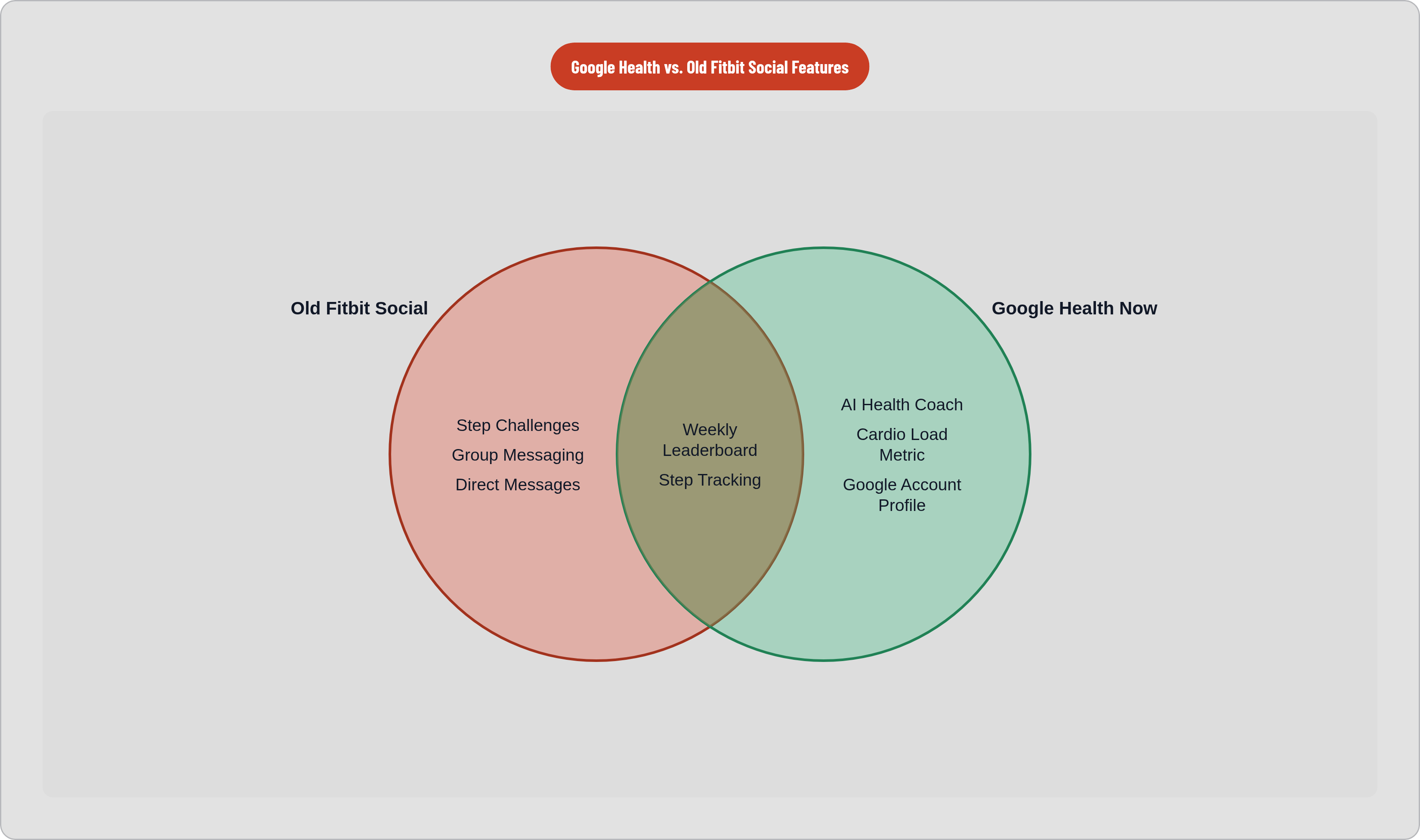
The first cut came in March 2023. That's when Google quietly removed Challenges, Adventures, and Open Groups from Fitbit. Not obscure settings buried in a menu. We're talking Workweek Hustle, Weekend Warrior, Daily Showdown, Adventure Races. The features people actually talked about. The ones that made you check your wrist at 9 PM because your coworker was 200 steps behind and you could feel them closing in.
These had been part of the platform since 2017. Nearly every competing wearable eventually cloned some version of them. That's how you know something worked.
Google's official reason was "streamlining" ahead of deeper Google integration. Users were not convinced. The backlash was loud and sustained. Nothing changed.
Then the May 2026 rebrand arrived and finished what the cuts started:
- Groups were removed
- The Community Feed was removed
- Direct messages between users were removed
- User-to-user notifications were removed
- Badges were removed. Including ones you had already earned. Google confirmed historical badges would be deleted entirely.
For families with kids: children can no longer add or have friends inside Google Health. If you were using Fitbit as a family accountability tool with younger kids involved, that use case is currently off the table.
Your profile changed too. The social identity you built around a custom Fitbit username and photo is now just your Google Account name, email, and photo. No custom usernames. No custom profile pictures. The platform is more Google now, and much less the thing you actually signed up for.
What Shared Tracking in Google Health Actually Looks Like Now
The weekly leaderboard survived. That's the main thing. It lives in the Fitness tab and is the primary tool left for anyone trying to stay connected with a friend or partner through the app.
Here's what it actually does:
- Shows friends ranked by weekly step count or Cardio Load
- Lets you toggle each metric on or off under "Leaderboard metrics"
- Updates regularly so you can check where you stand
To add someone: tap Friends and Family, then "+ Add Friends," and search by name or email.
Here's what it does not do:
- No direct messaging
- No challenge invitations
- No mid-week nudges tied to what a friend just did
- No group spaces where a few people can share something together
The leaderboard gives you a weekly competitive snapshot. That's genuinely useful. But it's a scoreboard sitting in an empty room — the numbers are there, yet the game around them is not.
Why These Social Features Mattered for Motivation in the First Place
This is the part companies never explain when they cut social features. They frame it as cleaning up the interface. In practice, they are removing behavior change mechanisms that took years of user psychology research to understand.
There's a well-documented phenomenon called the Köhler motivation gain effect. The short version: people work harder when their effort is part of something shared. Not because they consciously decide to try harder. It just happens. A 2023 meta-analysis in Kinesiology Review looked at 19 peer-reviewed studies with nearly 2,000 participants and found effort increases of up to 24% when exercise had a conjunctive structure. Meaning both people's contributions count toward a shared outcome. The old Fitbit challenge format was a near-perfect application of this. When you and a friend were in a Workweek Hustle, both your steps mattered to the result.
A weekly leaderboard creates social comparison, which has its own motivational value. But it removes the sense that your effort is required for something shared to succeed. That's one of the two core mechanisms, and it's gone from the native app.
The relational piece matters just as much. A 2021 study tracking adults in romantic relationships over two weeks found that exercising with a partner correlated with better mood during the workout, better mood for the rest of the day, and higher relationship satisfaction compared to solo exercise days. Not trivial outcomes.
And for anyone who thought the group messaging boards were just noise: a study using Fitbit's private group boards during a 10-week intervention found that participants who posted at least once per week logged significantly more steps and significantly more total activity minutes than those who didn't. The social layer wasn't decoration around the "real" health tracking. It was part of what made the tracking change behavior in the first place. You could say the community was the cardio.
How the AI Health Coach Fits (and Doesn't Fit) Where Social Features Used to Be
Google Health Premium includes access to the Google Health Coach, powered by Gemini. When Google removed badges, they pointed to the coach as a partial replacement, describing it as something that would "help to celebrate your progress and accomplishment."
Premium runs $9.99 per month or $99 per year. That's up from Fitbit Premium's previous annual rate of $79.99. So you're paying more, for a different set of features than the platform originally offered. The coach is also restricted to users 18 and older and requires a Fitbit or Pixel Watch device.
What the coach is actually good at:
- Personalized guidance based on your specific health data
- Adaptive recommendations as your patterns change
- Proactive check-ins based on what it sees in your metrics
What it cannot replicate: the moment your partner texts you "I'm almost at my step goal and it's 11:58 PM." The Google Health Coach is a personal trainer who only knows one of you exists. It responds to one person's data. It has no awareness of the dynamic between two people, no ability to see that one partner has been crushing it while the other is having a rough week, and no way to do anything with that information even if it could.
A 2025 study on Fitbit user behavior found that social features, specifically sharing achievements and competing with friends, contributed to motivation in ways consistent with Self-Determination Theory. The idea is that external social pressure and accountability can, over time, become internal motivation. The AI coach delivers encouragement. It cannot create the relationship dynamic that powers that progression.
For couples, the coach is a solo tool dressed in social clothing. It is useful. It is not what was removed.
Third-Party Apps That Recreate What Google Health Removed
The good news: your Fitbit hardware still works fine. The gap is entirely in the app's social layer, and there are tools built specifically to fill it.
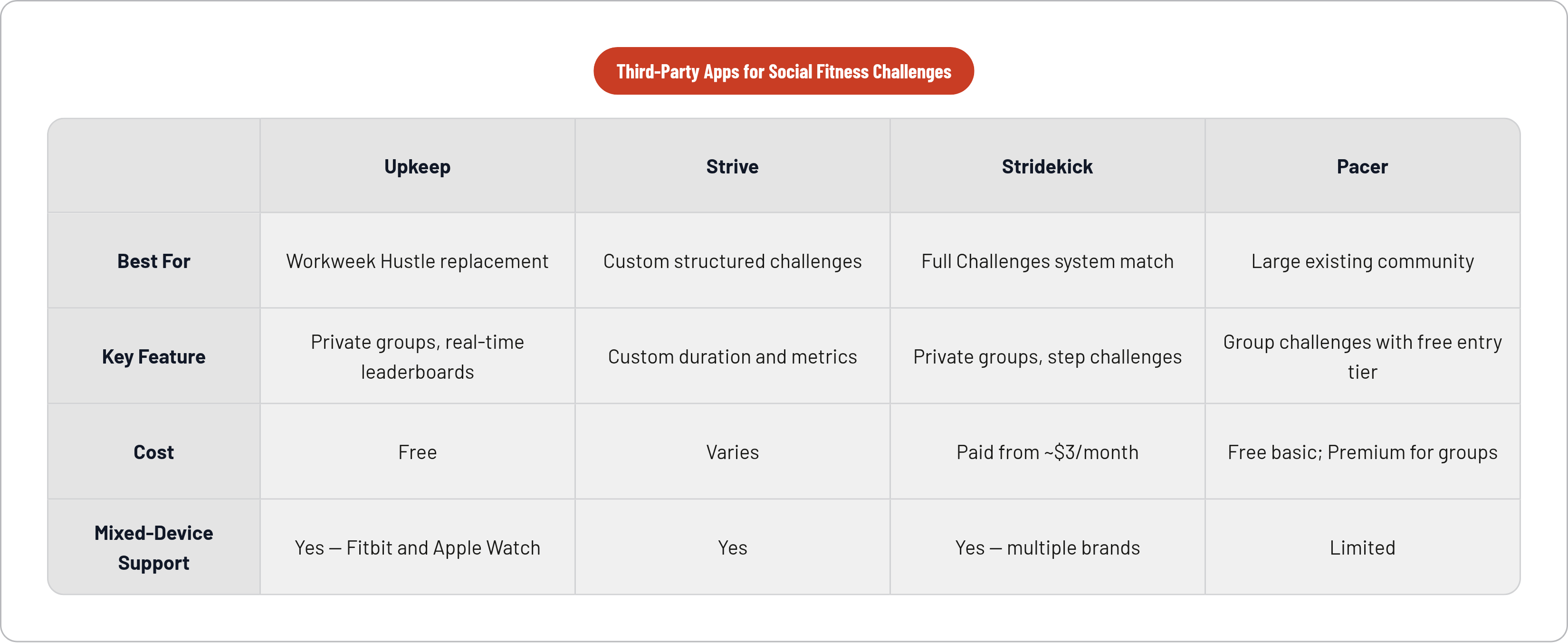
Upkeep is free and was built explicitly to replace the Workweek Hustle format. Private friend groups, weekly step competitions, real-time leaderboards. It syncs with Google Fit on Android and Apple Health on iOS, which means a couple with different devices (one Fitbit, one Apple Watch) can still compete in the same space.
Strive lets you build custom challenges with your own start date, your own duration (one to ten weeks), and your own choice of metrics. Steps, miles, calories burned, exercise minutes. If you and a partner want more structure than a rolling weekly leaderboard, this is the one to look at.
Stridekick is the closest feature-for-feature match to the old Fitbit Challenges system. Private groups, step challenges, support for multiple device brands. It's entirely paid, starting at a few dollars per month, but it doesn't cut corners on what it offers.
Pacer has been around long enough to have a large existing user base. Group challenge features sit behind Pacer Premium, which runs about a few dollars per month or a modest annual fee. Basic step tracking is free, which makes it a reasonable starting point before you commit.
One practical filter before anything else: if you and your partner have different hardware brands, start there. Upkeep and Stridekick both support multiple device types, which makes them the safest bets for mixed-device situations.
No single app does everything the old Fitbit social layer did. The right choice depends on whether cost, feature depth, or simplicity matters most to you.
What Couples and Friends Can Realistically Do Inside Google Health Today
The leaderboard is your foundation. Use it. Check it. Reference it in conversation. Let it create a little friendly pressure. Just don't expect it to run the game for you, because it won't nudge either of you mid-week, and it won't generate the back-and-forth that actually drives behavior.
Steps and Cardio Load are the two metrics you can compete on. Cardio Load is actually a meaningful addition for couples who do varied workouts, not just walking. If one of you runs and the other lifts, you finally have a shared metric that captures effort across different activity types.
For everything else, you build it yourself. That's not a workaround. That's just the current reality of the app.
Pick a third-party app if you want actual challenge structure. Use a shared message thread for real-time trash talk and encouragement. Send a workout photo. It sounds almost too simple, but a photo exchanged between partners carries more weight than a leaderboard position ever did. The research on social engagement and activity levels is consistent on this: the connection is the mechanism, not the specific feature delivering it.
Agree on goals directly. Two people deciding together, over text or in person, what the week looks like. That kind of agreement is more durable than waiting for an app to prompt it. And honestly? It works better.
There's a broader pattern worth knowing about. A 2025 study found that sharing wearable data on social platforms rose to 73% of surveyed users in 2023, up from 35% in 2016. People have been building their own social layer around health apps for years, outside of whatever the native app provides. Couples doing this aren't improvising badly. They're ahead of the curve.
The Fitbit hardware is still capable. The current limitation is the app's social scope. Knowing that distinction is what lets you build a connected routine now, without waiting for the app to become something it isn't.