How Couples Build a Lasting Workout Habit Using Weekly Goal Rituals Instead of Rigid Schedules
Weekly goals and photo check-ins keep couples accountable without rigid schedules.

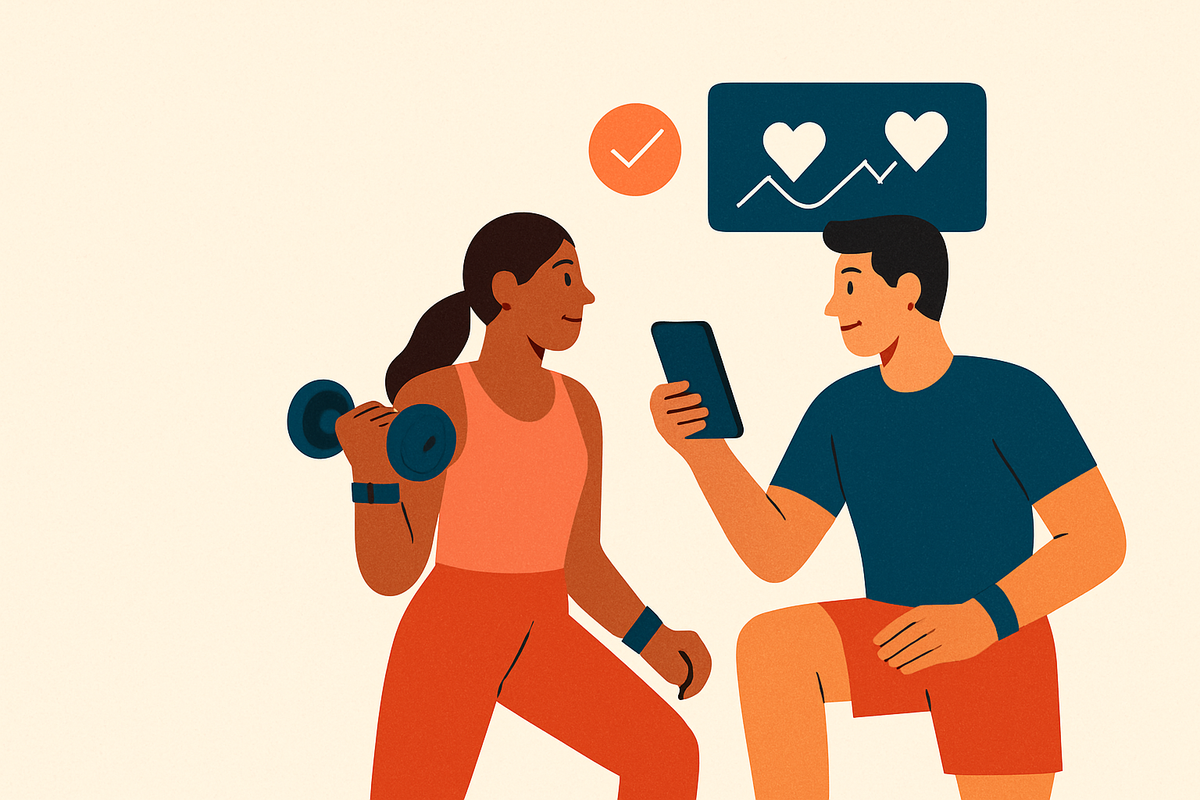
Couples can hold each other accountable to work out by agreeing on a weekly session goal, sharing a private SweatCam photo at each workout, and reviewing the week together with a small, optional wager. This weekly ritual keeps the commitment in place while letting workout times change.
Why fixed workout schedules fail couples specifically
The usual advice sounds tidy enough. Same gym, same time, same days. But a workout fixed at 8:15 a.m. now depends on two mornings going to plan. If either partner runs late, they lose their workout together even when the other is ready. A routine built for two has two independent sources of disruption.
Mismatched work shifts make that weakness especially clear. When one partner’s work hours change, the other can lose their workout slot even though nothing in their own day has changed. The fallback is to reschedule, which adds a coordination task just when time and motivation are already scarce. Exercise starts to need as much planning help as a small wedding. Repeated renegotiation also raises the cost of returning after a miss, because someone may feel they have let their partner down. Partners need to find another free hour and rescue the plan without making the relationship responsible for its failure.
What weekly goal rituals actually are and how they differ from schedules
A weekly goal ritual has three parts: a goal for how many sessions to do, proof of effort at each session, and a review together when the week ends. The couple chooses the goal together but completes the workouts independently as time allows. The number stays fixed for that week. So does the ritual at the end of the week, while the day and time of each workout can change. This replaces the shared schedule rather than creating a slightly more forgiving version of it.
For beginners, that might mean agreeing on three sessions across the week. One partner can exercise early while the other trains later, without either session counting as a departure from the plan. If Tuesday falls apart, Thursday remains available. No joint calendar repair is required.
Milkman et al.’s 2021 study in Management Science found that flexible exercise incentives generated more gym visits than incentives tied to a fixed daily two-hour window. After the incentives ended, the flexible group showed roughly twice the gym-visit likelihood of the routine group. That finding supports flexibility. It also gives the weekly approach a sound rationale, since a disrupted day need not remove the chance to follow through. The study’s comparison challenges the idea that repeating an exact workout time is always the better route to a durable habit, though it did not test this entire ritual.
How can partners motivate each other without constant reminders? The SweatCam photo check-in
SweatCam makes the check-in a photo rather than another conversation about whether the workout happened. Seeing a partner mid-workout at 6 a.m. makes effort visible in a way that a “workout logged” notification does not. The photo is private between partners and never publicly accessible. There is no audience to impress here. The photo lets the person sharing the commitment see the effort, even when they are hours or miles away.
That gives each session a shared ending. Taking the photo is the act of checking the box, while seeing it lets the other partner recognize a completed workout. Progress becomes something both people can experience rather than something one must remember to report later. This is the useful completion effect behind the check-in. Instead of relying on repeated reminders, the ritual gives each person a way to make their own follow-through visible.
SweatCam deliberately keeps its design simple by omitting logs of workout type, duration, or performance metrics. Its job is accountability within the relationship. For people who have been exercising for a while, it can work alongside their performance-tracking tools without replacing them, because training data and encouragement from a partner meet different needs. The photo keeps attention on showing up during weeks when performance dips, rather than making every check-in a verdict on results.
That small action needs to stay small in practice. If the camera does not open smoothly, the interruption arrives at the exact moment the session should feel complete. Set up SweatCam before the first workout. A check-in should not turn into tech support in gym clothes.
Why the wager closes the week instead of leaving goals open-ended
A weekly number can feel like a mere suggestion if nothing happens when the week ends. A small wager gives that endpoint a consequence. The deal is easy enough to remember without a lawyer. A partner who misses the agreed goal owes something small, such as buying dinner or doing a chore, while a partner who meets it does not. The commitment now adds a social cost to private resolve.
The wager is opt-in, and partners can adjust it to fit their relationship. Its usefulness comes from being concrete and immediate while keeping expense and intimidation low. The other person will know whether the commitment was met. That is the distinction between external accountability and self-monitoring, where the person setting the goal is also the only person reviewing it. The weekly close turns the photos and the target into a decision about whether each partner followed through.
A playful consequence can make it easier to accept being held to a goal, while a harsh penalty can push the relationship toward one partner controlling the other. Missing the goal should also prompt reflection about what got in the way, free of shame about being the less committed partner. This is a game between two people on the same side.
What the BYU research says about exercising together and what it means for couples who train apart
The BYU study published in Family Relations found that couples who exercised together said they communicated better, worked through conflicts better, and had less conflict in their marriages than couples who did not. The researchers looked at data on young married couples in the nationally representative CREATE study. Both individual and shared exercise were associated with healthier marriages. Exercising together was consistently more strongly linked to things going well in the relationship, including listening better and feeling more heard and supported.
Walking was the most commonly reported shared activity. That makes the finding relevant to couples who assume exercising together requires matching gym memberships or identical training programs. The shared activity did not have to look elaborate. However, the study used a single wave of longitudinal data, so it cannot establish whether exercising together improves a relationship or whether stronger couples are more likely to exercise together. The association is meaningful, but its causal direction remains unresolved.
Both partners still have a part in choosing the goal, seeing the effort, and closing the week. A photo gives partners a small way to connect without having a full conversation. That can fit long-distance and non-cohabiting partners as well as couples whose working hours rarely align. The research does not establish that photo check-ins produce the same benefits as exercising side by side, but the ritual preserves a shared relationship practice when a shared workout is not possible.
The one genuine risk of flexible scheduling and how the weekly ritual handles it
Flexible timing has a real weakness when every session remains permanently postponable. Choosing when to exercise can become one more choice to put off, especially in a busy week. Tomorrow always looks as though it has its act together. Without an anchor, the weekly number can seem to matter even though no single workout ever feels like it needs to happen now. By Saturday night, the problem is no longer a missed time slot but a week that has run out.
The closing wager puts a boundary around that openness. Moving a workout is allowed, but moving the whole commitment beyond the agreed weekly close has a cost. If the week closes on Friday, delaying until Friday is different from delaying past it.
The photo check-in supplies the other constraint by making progress visible before the deadline arrives. Each completed session gets its own moment of recognition rather than disappearing into a number reviewed only at the end. That gives partial progress a place in the week. For beginners, completing and photographing an early session can create momentum for the next one, instead of leaving the whole target untouched until the final stretch. Together, the check-in and the closing consequence address two different problems, which are effort going unnoticed and delay going unbounded.
Neither constraint requires one partner to police the other’s calendar. The check-in shows what has happened, while the wager defines when the commitment comes due. Both are agreed before the week gets messy. That is why this is more than “work out whenever”, which leaves every decision open. Flexibility works here because the timing can move inside a commitment that does not.
How to set up a weekly ritual that fits a real couple’s actual week
To put the structure into practice, start with the number both partners can reach in a normal week without heroics. A brief Sunday conversation can establish the goal without turning it into a planning meeting. A target that depends on perfect conditions imports the same fragility as the rigid schedule, just with fewer calendar entries.
For beginners, three sessions per week is a reasonable anchor, and those sessions can be short and simple. A walk can count toward the agreed goal. The BYU finding gives walking a place in the relationship discussion, though it does not prescribe a training target. More active partners can choose a higher number while keeping the same structure. Different fitness levels do not require identical workouts, because the shared agreement is about each person following through on their number.
Before the first session, set up SweatCam so the photo check-in is easy to complete. Then choose a wager that both partners find funny and neither finds stressful. If one partner dreads the consequence, lower the stakes rather than treating discomfort as proof that accountability is working.
At the weekly close, review whether both partners hit their number and reflect on any missed goal without turning it into a character judgment. Agree on the next week’s target together, and set pride aside to revisit it when life changes significantly. Real life gets a vote in the plan. This is not a fitness optimization system built to make two people train alike. The workout is the point, but showing up for each other is the habit to build.